 TradeBB
PROP FIRM TOOLS
Consistency Rule Calculator
Check your best day against your prop firm's consistency rule, and see how much more profit you need.
A consistency rule limits how much of your total profit can come from your single best trading day. Your consistency score is your best day's profit divided by your total profit. If it's above your firm's limit, you usually need more profit on other days before you pass or get paid.
The formula
How the consistency rule is calculated
- Find your best day — the single day with the largest profit in the period your firm counts
- Find your total profit — usually net of losing days
- Divide — and compare with your firm's limit
If you're over, best day ÷ limit gives the total profit you need. For example, a $1,300 best day under a 50% limit needs $2,600 in total. With $2,500 so far, that's $100 more, as long as your best day doesn't grow.
For a full walk-through with five trading days, see the consistency rule, explained.
Losing days
Why a losing day raises your score
At most firms, total profit includes your losing days. A losing day makes the total smaller while your best day stays the same, so your best day becomes a bigger share.
| Day | Result | Total so far | Best day's share |
|---|---|---|---|
| 1 | +$1,300 | $1,300 | 100% |
| 2 | +$400 | $1,700 | 76.5% |
| 3 | −$300 | $1,400 | 92.9% |
| 4 | +$500 | $1,900 | 68.4% |
| 5 | +$600 | $2,500 | 52.0% |
After day 3, the score went up even though nothing about the best day changed. Enter your days one by one in the calculator's Daily results mode and it shows what your losing days did to your score.
Below or up to
"Below 50%" and "up to 50%" aren't the same
Firms word their limits differently, and the difference matters when you land exactly on it.
- Up to (≤) — exactly 50% is inside. $1,300 best day, $2,600 total: you're done
- Below (<) — exactly 50% is still over. The same days need a little more than $2,600
Each preset in the calculator uses its firm's wording. If you pick Custom, choose which one your firm uses.
Firm rules
Consistency rules in this calculator
Checked against each firm's own help center on October 22–23, 2026. Rules change often, so confirm with your firm before you rely on a number.
| Firm and account | Limit | Applies to | If you're over |
|---|---|---|---|
| Alpha Futures, Standard Evaluation | 50% or less | Passing the evaluation | Keep trading until you're inside |
| Alpha Futures, Advanced Evaluation | 40% or less | Passing the evaluation | Keep trading until you're inside |
| Alpha Futures, Zero and Standard Qualified | Below 40% | Payouts | Payout waits; resets after each payout request |
| Alpha Futures, Direct Qualified | Below 20% | Payouts | Payout waits; resets after each payout request |
| Topstep, Trading Combine | 55% | Passing the Combine | Your profit target goes up |
| Topstep, Express Funded (consistency payout path) | 40% or less | Payouts | Payout waits; resets after each payout request |
| Take Profit Trader, Test | Below 50% | Passing the Test | Your profit target goes up to more than twice your best day |
| Apex, Performance Account | Below 50% | Payouts | Payout waits; resets after each approved payout |
| Lucid Trading, LucidFlex evaluation | 40% or less (50% with add-on) | Passing the evaluation | Keep trading until you're inside |
| Lucid Trading, LucidPro funded | 40% or less | Payouts | Payout waits; resets after each payout |
| MyFundedFutures, Rapid EOD evaluation | 30% | Passing the evaluation | Keep trading until you're inside |
| MyFundedFutures, Rapid Intraday and Pro evaluation | 50% | Passing the evaluation | Keep trading until you're inside |
| Tradeify, Select evaluation | 40% or less | Passing the evaluation | Keep trading until you're inside |
| Tradeify, Growth funded | 35% or less | Payouts | Payout waits; resets after each approved payout |
| Tradeify, Lightning funded | 20%, then 25%, then 30% or less | 1st, 2nd, 3rd+ payout | Payout waits |
| FTMO, 1-Step (orders from Oct 12, 2026) | 50% or less | Challenge and funded account | Keep trading until you're inside |
| Earn2Trade, evaluation | Below 30% | Passing the evaluation | Keep trading until you're inside |
None of these firms treats going over as a rule violation. The cost is time: more trading days under the same loss limits, and if your firm uses a trailing drawdown, more days for it to catch you. For the rest of Topstep's rules, see Topstep rules.
Your best day
Your best day is worth a second look
A consistency rule is really asking one question: did most of your result come from a single day? Before you trade toward a payout, look at that day's trades. If they were your normal setups at your normal size, you just need more days like the others. If it was one oversized position, the rule is pointing at something worth fixing anyway.
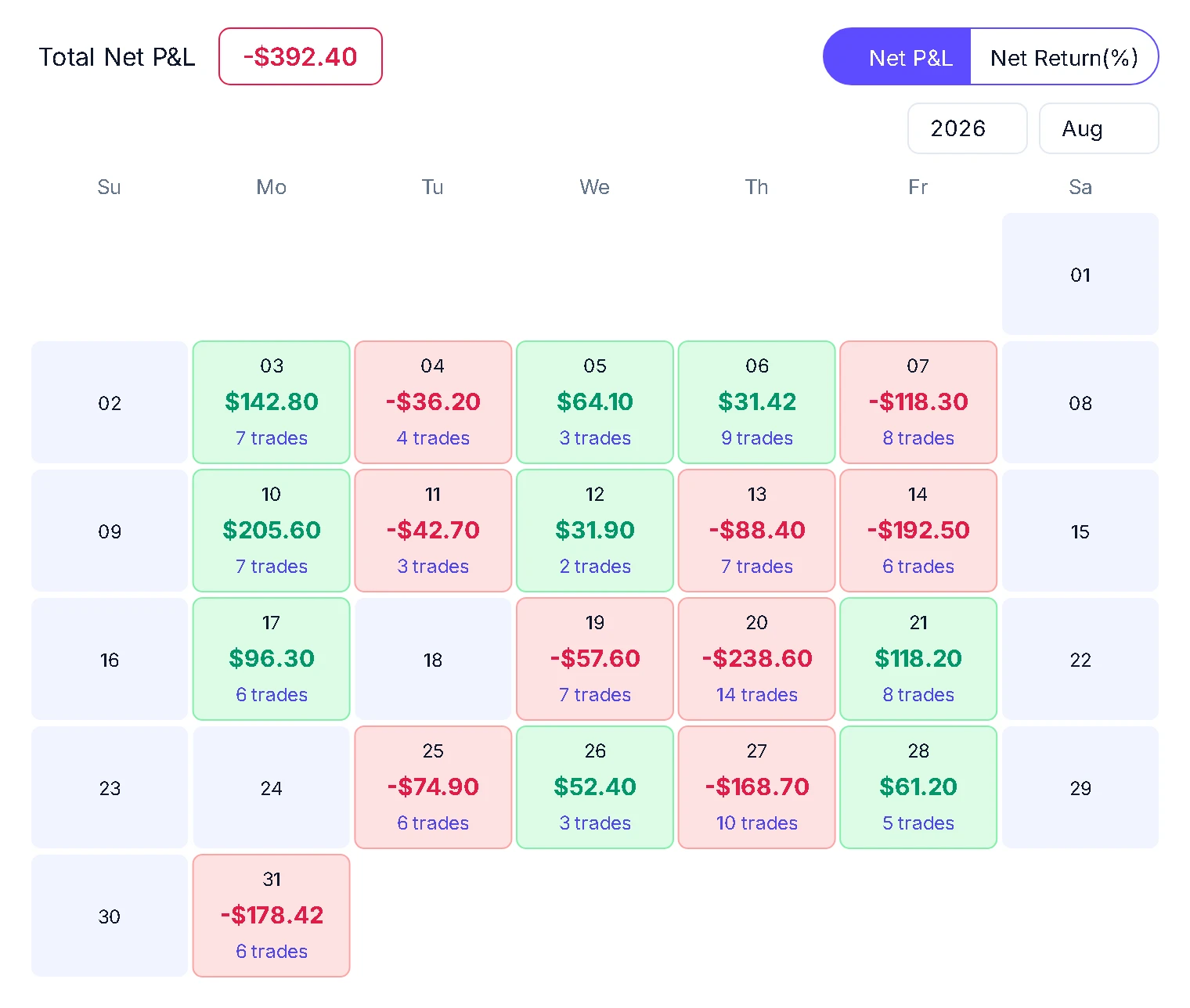
- Every day's result — on one calendar, with the month's total
- The trades behind your best day — one click from the calendar
- Days since your last payout — pick the date range your firm counts
A trading journal keeps the numbers this calculator needs in one place. The prop firm trading journal shows each account's results side by side.
FAQ
Frequently asked questions
How do you calculate the consistency rule?
Divide your best day's profit by your total profit for the period your firm counts. If the result is above the limit, divide your best day by the limit to get the total you need.
Do you fail if you break the consistency rule?
At the firms in this calculator, no. Depending on the firm, your profit target goes up, your payout waits, or you keep trading until your best day's share comes down.
Do losing days count in the consistency rule?
At most firms, yes. Total profit is net of losing days, so a losing day raises your best day's share. Use the Daily results mode to see the effect.
Is exactly 50% a pass?
It depends on the wording. "Up to 50%" or "50% or less" includes 50%; "below 50%" doesn't. The firm presets use each firm's wording.
Which days should I enter?
The days your firm counts: the whole evaluation, or for payout rules, usually only the days since your last payout. Many firms reset the count after each payout.
Is my data stored?
No. The calculator works in your browser and doesn't need an account.
Know your best day's share before your firm does.
Bring in your trades and see every day's result, your best day and your total on one calendar.