
In the ups and downs of candlestick charts, some credit profits to precise technical analysis and blame losses on bad luck. But seasoned traders know the truth: trading is essentially a game of human nature. 80% of losses stem from unregulated psychology—greed makes you chase highs and get stuck, fear forces you to sell low at the bottom, and overconfidence makes you deviate from established strategies. The truly successful traders never conquer the market; they tame their own minds. And for this journey, a reliable "mental training tool" is indispensable—TradeBB’s structured trading journal is exactly that.
Trading psychology is never about "eliminating emotions," but learning to coexist with them. Just as a ship doesn’t need to fight storms but only calibrate its course, traders don’t have to suppress joy, anger, sorrow, or joy. The key is to let rationality become the "navigation system" for emotions. TradeBB’s core value lies in transforming abstract psychological activities into quantifiable, reviewable data—turning mental training from empty self-suggestion into actionable, traceable practice. In this article, we’ll break down how to combine trading psychology with tool empowerment to build a dual profit system of "cognition + tools."
Emotions as Signals: TradeBB as the Signal Tower
Many traders fall into the trap of believing they must be "emotionless" to profit, rigidly suppressing fear and excitement. But emotions are merely instinctual response signals to market changes. What truly devastates a portfolio is the misinterpretation and blind obedience to these signals. TradeBB helps you "file" your emotions, turning you from a slave to your feelings into an objective observer.

- The Signal of Greed: FOMO Trading When you feel the urge to chase a hot asset, immediately use TradeBB’s Custom Tag feature to mark the trade as #EmotionalTrade/FOMO. Associate it with the entry criteria in your trade log. Later, by filtering through the platform’s Strategy Tag Analysis, you will clearly see the historical win rate and average loss for these specific trades. Using this cold data counters self-recrimination, giving your rationality a "data-backed rebuttal" the next time that "fear of missing out" signal appears.
- The Signal of Fear: Irrational Cutting When holding a losing position and the urge to cut rises, open TradeBB's "Plan vs. Execution Deviation Analysis" module. Compare the current loss against your predetermined Max Risk Tolerance (R) and stop-loss level. The platform automatically computes the long-term performance of such stop-out trades, helping you distinguish between a "Rational Stop-Loss" and a "Panic Exit."
- The Signal of Overconfidence: Cognitive Bias After a string of wins, you might impulsively scale up your position size. TradeBB's Cumulative P&L Curve provides a sobering check. By reviewing the history of trades labeled "Scaled up after 3 consecutive wins," the data will starkly reveal that overconfidence often marks the beginning of a profit drought.
Conclusion: By using the tool to "tag + quantify" your emotions, TradeBB becomes the crucial bridge connecting your emotional state to rational analysis.
Build a Mental Defense with "TradeBB + Self-Awareness"
Trading psychology isn’t a castle in the air; it needs to be rooted in "clear self-awareness" and "flexible trading plans." TradeBB’s structured journaling features make self-awareness more precise and trading plans more executable, putting an end to "trading on feeling."
Self-Awareness: Draw a "Visual Mental Map" with TradeBB
Instead of vaguely "listing impulsive tendencies," use tools to accurately identify your "mental weaknesses." TradeBB’s standardized fields and data analysis functions make self-awareness free from vague guesswork:
- Automatically generate a "cognitive bias checklist": Based on your trading records, the platform calculates P&L data corresponding to high-frequency tags (e.g., "herd trading," "anchoring effect"). For example, you’ll find that trades affected by "anchoring to entry price" account for 60% of losses—far more convincing than subjective lists.
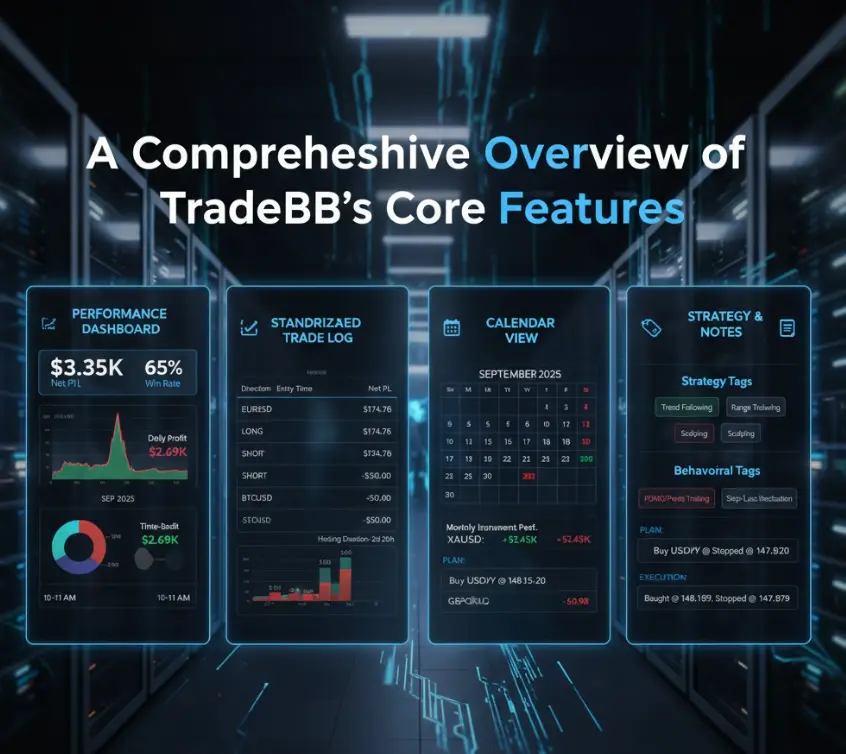
- Precisely mark "emotional triggers": After each trade, record your current mood (e.g., "impatient after 2 consecutive losses") in TradeBB’s "Notes" module. Over time, the platform’s "Calendar View" will clearly show the correlation between emotions and P&L—for instance, you’re prone to impulsive trading due to fatigue every Wednesday afternoon, helping you set early warnings.
- Quantify your "mental tolerance threshold": TradeBB’s "Account Overview" real-time calculates your maximum consecutive losses and daily maximum drawdown. Combined with your risk preferences, it automatically alerts you when "the current position exceeds your mental tolerance," preventing you from crossing the line in decision-making.
Trading Plans: Build a "Dynamic Navigation System" with TradeBB
A actionable trading plan is never a rigid "instruction manual," but a "dynamic navigation system" that adapts to market changes. TradeBB visualizes the entire process of plan formulation, execution, and adjustment:
- Align core elements with one click: Preset capital allocation ratios and risk-reward ratios in TradeBB, and link mental emergency plans through "strategy tags." For example, set an automatic reminder for trades with "floating losses exceeding 10%." When triggered, the platform will pop up a prompt to "pause trading for 1 hour," forcing rational intervention.
- Multi-dimensional adjustment windows: The platform supports unified management of multiple assets including stocks, options, and futures. You can use "asset category filtering" to view the win rate and profit contribution of different categories. For example, if you find that forex trades account for 70% of profits, adjust capital allocation in a timely manner to align your plan with market trends.
- Emotional buffer zones take effect automatically: Use TradeBB’s "delayed execution" function (supported by some broker integrations) to set "execute 15 minutes after a buy signal is issued." At the same time, the journal requires you to fill in "3 entry reasons" compulsorily, avoiding impulsive orders driven by emotions.
Use TradeBB’s Data Analysis to Master Market Rhythm
Patience and adaptability in trading are essentially resonance with market rhythms. TradeBB’s refined data statistics help you accurately identify your "trading comfort zone," making patience purposeful and adaptation evidence-based.
Patience: Lock in "High-Value Trading Windows" with Data
Genuine patience isn’t "waiting idly," but "observating with purpose." TradeBB’s time-dimensional analysis saves you from blind waiting:
- Filter "high-win-rate time periods": Through the platform’s "hourly win rate statistics," you may find that your trading win rate is 75% between 10-11 AM, but only 30% after 3 PM. From then on, focus on high-value time periods and wait calmly at other times—let data replace "waiting by feeling."
- Quantify "optimal holding duration": TradeBB automatically calculates the average holding time of all your profitable trades (e.g., 4 days and 7 hours) and losing trades (e.g., 1 day and 2 hours). This helps you develop the habit of "holding profitable trades longer and not clinging to losing ones," avoiding leaving early due to impatience or delaying stop-loss.
Adaptability: Verify the "Effectiveness Boundaries of Strategies" with Tools
The market never behaves as you expect. Adaptability doesn’t mean abandoning strategies, but using data to judge their scope of application. TradeBB’s strategy tagging and performance analysis functions make adjustments more scientific:
- Distinguish between "trend reversals" and "short-term fluctuations": Tag different strategies (e.g., "trend following," "range trading") and use TradeBB’s "strategy performance comparison" to view their performance in different market environments. For example, if you find that "trend following" has an 80% loss rate in sideways markets, switch strategies in a timely manner instead of being stubborn.
- Small-position testing + data feedback: Use TradeBB’s "position statistics" function to record the results of 10% test positions. The platform automatically calculates the expectancy (average profit per trade) of such trades. If the expectancy is positive, gradually increase the position to control risks during the adaptation process.
Ultimate Wisdom: Use TradeBB’s Review Function to Turn Wins and Losses into Nutrients
Being complacent with profits and self-deprecating with losses is a common trap for traders. TradeBB’s structured review function gives every trade "reusable value," making "staying humble in victory and resilient in defeat" more than just a slogan.

Embrace Profits: Use Data to Distinguish "Luck from Skill"
After significant profits, the greatest danger is complacency. TradeBB helps you stay sober:
- Automatically split profit composition: The platform calculates the proportion of "strategy-based profits" and "accidental profits" in profitable trades. For example, if 90% of a profit comes from unexpected market news rather than strategy execution, it reminds you "this is luck, not replicable," preventing you from increasing positions blindly.
- Solidify experience through reviews: In TradeBB’s "Trading Notes," compulsorily record the "key nodes" of profitable trades (e.g., entry signals, position management, take-profit timing) and tag them as "replicable." Later, use "tag filtering" to compile all successful cases into your own profit template.
Accept Losses: Use Tools to Dissect "Root Causes and Improvements"
After a loss, the first reaction shouldn’t be "to make it back quickly," but "to figure out why." TradeBB makes loss reviews more systematic:
- Enforce a "loss cooling-off period": Set "lock the account if daily losses exceed 5%" in TradeBB to force a trading halt and avoid emotional averaging down. At the same time, the platform automatically generates a "loss trade review checklist," guiding you to fill in key information such as "whether the plan was violated," "emotion tags," and "cognitive biases."
- Track improvement effects: Target the root cause of losses (e.g., "no stop-loss set") and use TradeBB’s "rule reminders" to require setting a stop-loss before placing an order. Through "before-and-after comparison analysis," check if the incidence of similar mistakes decreases after improvements, turning losses into real growth.
Conclusion: Tools Are Bridges, Discipline Is Core, Profits Are Results
Trading psychology training is never about creating an "emotionless robot," but nurturing a mature trader who "can coexist with emotions, understand market signals, and adhere to personal boundaries." Structured trading journal tools like TradeBB act as "navigators" and "recorders" for your mental training—they help you quantify emotions, verify strategies, and review gains and losses, turning abstract psychological games into concrete actions.
But remember: tools are always auxiliary. TradeBB can provide clear data and direction, but it can’t replace your discipline and execution. When you learn to interpret emotions with data, constrain behaviors with rules, and optimize cognition through reviews, you’ll find that trading profits are simply the natural result of mental maturity.
May you use TradeBB to capture market patterns amid the ups and downs of candlesticks, and gain peace and insight through inner practice—ultimately becoming a profitable trader with both "cognition and tools."