

Disclaimer:Trading leveraged instruments through proprietary (Prop) firms is a high-stakes endeavor. Statistical data confirms that the vast majority of retail participants fail to clear the initial evaluation phase. The content provided in this guide is intended to enhance compliance awareness and does not represent financial guidance. In this context, a trading journal serves as a "Compliance Monitor," tracking your adherence to specific risk protocols; it offers no guarantee of passing an evaluation, securing funding, or receiving a payout.
The retail trading landscape has undergone a radical paradigm shift. Instead of eroding their own limited savings, thousands of traders are pivoting toward Proprietary Trading Challenges. These firms offer a compelling trade-off: demonstrate your risk management prowess through a rigorous test, and gain access to institutional capital in exchange for a performance-based profit split.
However, the reality of the funded trader industry is unforgiving. Many firms' profitability models are deeply tethered to evaluation fees, and the failure rate for challenges is notoriously high. Traders typically lose their accounts not due to a lack of technical skill, but due to the breach of minute, highly specific risk mandates.
In an environment where a single oversized position or a miscalculated trailing drawdown can instantly revoke a $100,000 account, trading without a record is professional suicide. You must operate as a "Compliance Architect," utilizing mechanical auditing to safeguard your trading privileges. This necessitates a journaling system built specifically for prop firm rules.
This guide examines the audit logic of a professional funded ledger, focusing on tracking dynamic drawdown metrics and ensuring your execution remains within institutional survival parameters.
The Proprietary Model: Why Standard Tracking Falls Short
If you attempt to log prop firm trades using a generic spreadsheet designed for a personal retail account, you are leaving yourself exposed to unexpected account breaches.
When you trade your own retail account, you answer only to yourself. If your account drops by 10% in a day, it is painful, but you can hold your positions and wait for a recovery. When you trade for a prop firm, dropping by 5% in a day often results in a "hard breach," instantly terminating your account and wiping out weeks of hard work.
A specialized prop firm trading journal must be designed around Compliance Tracking. It must account for the following unique mechanics:
- Equity vs. Balance Tracking: Most prop firms calculate their daily loss limits based on intraday equity (floating P&L), not just closed balance. A standard journal only records closed trades. A prop firm journal must account for the deepest floating drawdown a trade experienced while open.
- Consistency Rules: Many firms employ "consistency rules" to prevent gamblers from passing an evaluation with one lucky trade. Your ledger must track the percentage of total profit each trade contributes to ensure you remain compliant.
- Phase Segregation: Prop firm trading exists in distinct phases (Phase 1 Challenge, Phase 2 Verification, and the Funded Stage). Your journal must separate data across these phases, as the psychological pressures and risk parameters change drastically in each.
Auditing the Evaluation Phase vs. The Funded Stage
The lifecycle of a prop firm trader is divided into highly distinct psychological environments. A professional online prop firm trading journal allows you to categorize your trades based on which phase you are currently navigating.
Navigating the Challenge Phase (Phases 1 & 2)
During the evaluation phase, traders are typically required to hit a specific profit target (e.g., 8% or 10%) without breaching drawdown limits.
- The Journaling Goal: Here, the journal is used to track "Pacing." If you have a target to hit, your journal should calculate your required daily or weekly return. By logging your setups, you can identify if you are forcing sub-optimal trades just to meet the profit target, which is the number one cause of evaluation failure.
Surviving the Funded Stage
Once you pass the evaluation and receive a funded account, the rules of the game completely change. There are no longer any profit targets. The only goal is survival and reaching the first payout.
- The Journaling Goal: The psychological pressure in the funded stage is immense. Traders often become paralyzed by the fear of losing the account they worked so hard to achieve. Your journal must track your Risk-to-Reward Ratio meticulously here. The ledger should verify that you are risking a fraction of a percent per trade (e.g., 0.25% or 0.5%) to ensure that even a string of five consecutive losses will not bring you close to the daily drawdown limit.
Documenting Strict Drawdown Limits: The Core Metrics
The heartbeat of any prop firm trading journal is its ability to monitor and audit drawdowns. Prop firms utilize complex loss limits that require specialized data tracking.
The Daily Drawdown Limit
Most firms impose a daily loss limit, typically around 4% to 5% of the initial account balance or the midnight starting equity.
- Auditing Application: Your journal must track your cumulative daily P&L in real-time. More importantly, during your weekly review, you should filter your journal to review your worst trading days. If your journal shows you frequently hit -3% before rebounding, you are operating dangerously close to the breach threshold and must systematically reduce your position sizing.
The Maximum Trailing Drawdown
This is the metric that eliminates the most traders. A trailing drawdown follows your account's highest recorded balance (the high-water mark). If your account hits $105,000, and the maximum trailing drawdown is 6% ($6,300), your account breaches if it drops to $98,700—even though you are still technically profitable from your initial $100,000 starting balance.
- Auditing Application (MFE & MAE): To survive a trailing drawdown, your journal must track Maximum Favorable Excursion (MFE) and Maximum Adverse Excursion (MAE). MFE tracks how far a trade went in profit before you closed it. MAE tracks how far into the red a trade went before closing. If your journal shows that your trades routinely float deep into profit (MFE) but you let them reverse to break-even or a loss (high MAE), you are unnecessarily dragging your trailing drawdown higher without securing profits. Your journal highlights the mathematical need to scale out of positions earlier.
Consistency Rules and Scaling Plan Metrics
Prop firms are in the business of identifying consistent, professional traders, not lottery winners. To enforce this, they utilize consistency rules and scaling plans, both of which require precise journaling.
Monitoring the Consistency Rule
A common prop firm rule dictates that no single trade can account for more than 30% or 50% of your total profit during an evaluation. If you make $10,000 to pass a challenge, and $6,000 came from one massive CPI news trade, the firm may reject your evaluation.
- Journaling Application: A proper ledger will automatically calculate the weight of your most profitable trade against your total P&L. By regularly reviewing this metric in your journal, you can ensure your equity curve is a smooth, upward slope of consistent base hits, rather than a flat line with one massive spike.
Tracking Scaling Plan Objectives
Top-tier prop firms offer scaling plans, rewarding consistent traders by increasing their capital allocation (e.g., scaling a $100k account to $1.5 million over time). These scaling plans usually require the trader to achieve a certain percentage of profit over several consecutive months.
- Journaling Application: Your prop firm trading journal acts as your professional resume. By tagging your trades and reviewing your monthly net returns, you can pace your trading to meet scaling requirements. If you know you only need a 2% return this month to qualify for a $50,000 capital increase, your journal tells you exactly when to stop trading and protect your capital.
The Psychology of Profit Splits and Payout Cycles
Because you are trading firm capital, you do not have instant access to your funds. Prop firms operate on specific payout cycles (e.g., bi-weekly or monthly). This creates a unique psychological phenomenon that must be audited in your behavioral notes.
The Payout Sabotage
It is incredibly common for a funded trader to be up 6% for the month, only to blow the entire account two days before the payout date due to greed or boredom.
- Journaling Application: Your journal must include a qualitative section for emotional auditing. You should tag trades taken within 48 hours of a payout date. During your review, if you notice a pattern of low-quality, impulsive executions right before you are due to receive a profit split, you have identified "Payout Sabotage." The data dictates a new operational rule: cease trading three days before any payout request.
Upgrading Your Tech Stack: Managing Multiple Accounts
As prop firm traders progress in their careers, they rarely trade just one account. A professional trader might simultaneously manage a $100k account with Firm A, a $200k account with Firm B, and a personal retail account. They often utilize third-party trade copiers to duplicate their executions across all platforms.
Attempting to track the daily drawdowns, consistency rules, and scaling metrics across three different accounts using Microsoft Excel is mathematically chaotic and highly prone to human error.
To manage this complex infrastructure, funded traders upgrade to dedicated performance analytics platforms. When evaluating software for prop firm compliance, look for solutions that provide:
- Multi-Account Aggregation: The ability to connect multiple broker APIs (e.g., MetaTrader, cTrader, Match-Trader) and aggregate the data into a single, unified dashboard, while still allowing you to isolate and view each account's specific drawdown metrics.
- Automated Risk Metrics: The system should instantly calculate your MFE and MAE, allowing you to see if your trade management is actively harming your trailing drawdown limits.
- Behavioral Tagging: The ability to tag trades by phase (e.g., "Phase 1," "Funded") to isolate how your win rate changes when you transition from simulated evaluations to live, funded capital.
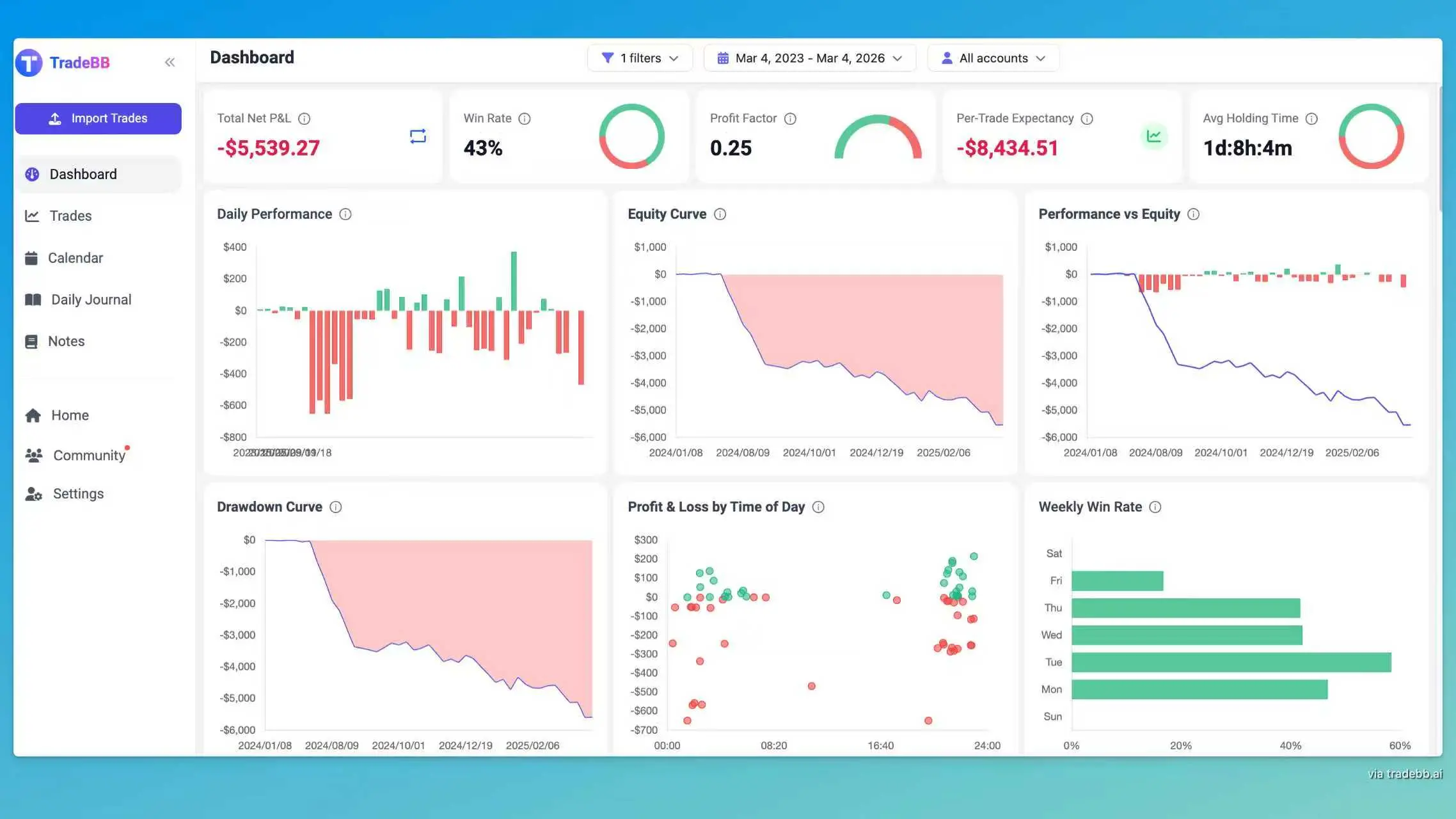
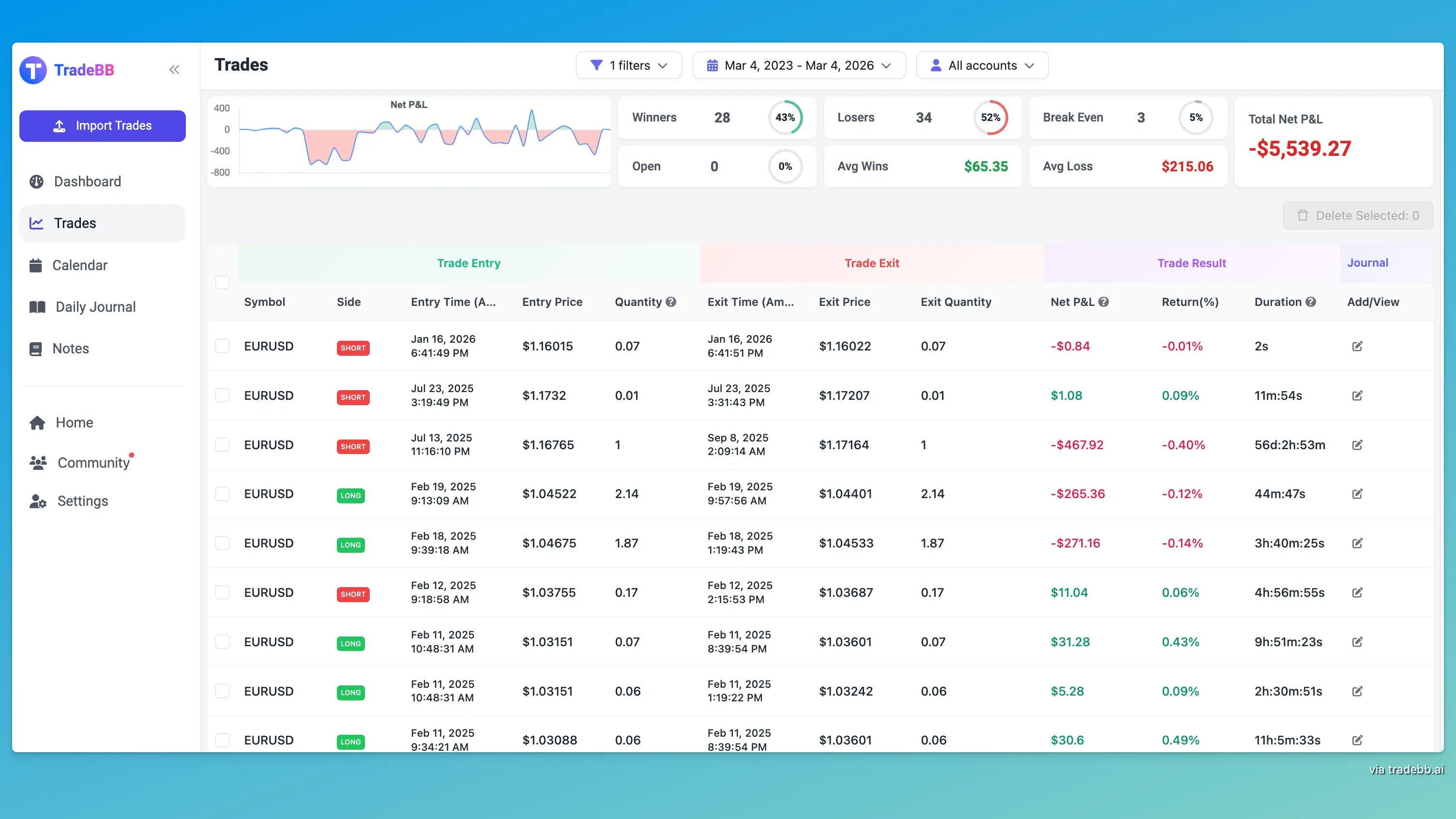
Tools engineered for comprehensive portfolio management, such as TradeBB, exist to eliminate the friction of compliance tracking. By visualizing your performance through the lens of risk management rather than just gross profit, these platforms act as your personal Chief Risk Officer, allowing you to focus on the charts while the software monitors your drawdown limits.
(Are you managing your personal retail capital alongside your prop firm accounts? Ensure you are tracking your personal assets with the appropriate frameworks. Read our specialized guides on building a Forex Tracking Framework and a Futures Margin Ledger.)
Frequently Asked Questions (FAQs)
Can I use a standard Forex or Futures journal for my Prop Firm accounts?
While the underlying assets you trade (currencies, indices) may be the same, a standard journal focuses only on P&L and win rate. A prop firm journal must specifically track intraday equity drawdowns, high-water marks, and consistency rules. If your software cannot track MFE/MAE, it is not optimized for prop firm compliance.
Why do I keep passing evaluations but losing funded accounts?
This is the most common issue in the prop firm industry, and it is entirely psychological. During an evaluation, traders use higher risk to hit the profit target. Once funded, they fail to reduce their risk profile, leading to rapid drawdown breaches. A journal helps you visualize this discrepancy by tracking your average risk per trade across different account phases.
How does journaling help with Maximum Trailing Drawdowns?
Trailing drawdowns are triggered by your account's highest open equity. If you are up $2,000 on a trade but let it close for only a $100 profit, your trailing drawdown limit has still moved up based on that $2,000 high-water mark. By journaling Maximum Favorable Excursion (MFE), you learn to take partial profits at the peaks, protecting your trailing drawdown threshold.
Should I journal trades differently if I use a Trade Copier?
If you use a trade copier to execute across multiple prop firms simultaneously, you should ideally use a journaling software that can aggregate those accounts. However, be aware that different prop firms have different spreads, slippage, and commission structures. A trade that is profitable on Firm A might hit the stop loss on Firm B due to spread differences. Journaling slippage across different accounts helps you identify which firm provides the best execution.
Does keeping a prop firm journal guarantee I will get a payout?
No tool can guarantee a payout or prevent account breaches. A prop firm journal is a risk-management and compliance tool. It provides objective, historical data regarding your past execution habits. It is up to the individual trader to review that data, recognize when they are nearing a drawdown limit, and enforce the discipline required to stop trading.
Authoritative Resources for Risk Management
To ensure your trading framework is built on sound institutional risk management principles, it is highly recommended to study the guidelines provided by authoritative regulatory bodies:
- Commodity Futures Trading Commission (CFTC): The U.S. government agency that regulates the derivatives markets. Their educational branch provides extensive resources on the realities of leverage, margin, and the statistical risks associated with simulated trading environments. (CFTC Customer Education)
- National Futures Association (NFA): The self-regulatory organization for the U.S. derivatives industry. The NFA provides critical educational resources regarding proper risk disclosures, margin requirements, and the mechanics of trade execution. (NFA Investor Education)
- Financial Industry Regulatory Authority (FINRA): While primarily focused on equities, FINRA's comprehensive resources on behavioral finance, risk management, and the psychology of trading are invaluable for anyone managing firm capital. (FINRA Investors)