 TradeBB
How to track options trades so the numbers add up

To track an options trade, record each contract you trade as its own line: the underlying, expiry, strike, call or put, the premium you paid or received, the number of contracts, and the fees. Then add why you took it and how well you took it.
That much fits in any spreadsheet. Options get hard at the edges: trades with several legs, contracts that expire, positions that get assigned, and rolls. This guide covers each, and walks one trade through from start to finish.
One trade, tracked in full
Here's a single options trade from a sample account, recorded completely.
| Field | Entry |
|---|---|
| Contract | QQQ Aug 21 2026 700 put |
| Direction | Long, 1 contract |
| Opened | Jun 11, 2026 at $29.71 |
| Closed | Jul 27, 2026 at $30.90 |
| Result | ($30.90 − $29.71) × 100 = $119.00 gross; $1.81 in fees; $117.19 net |
| Plan | Take profit at $35.00, stop at $25.00 |
| Strategy | Breakout |
| Rating | 5 / 5 for execution |
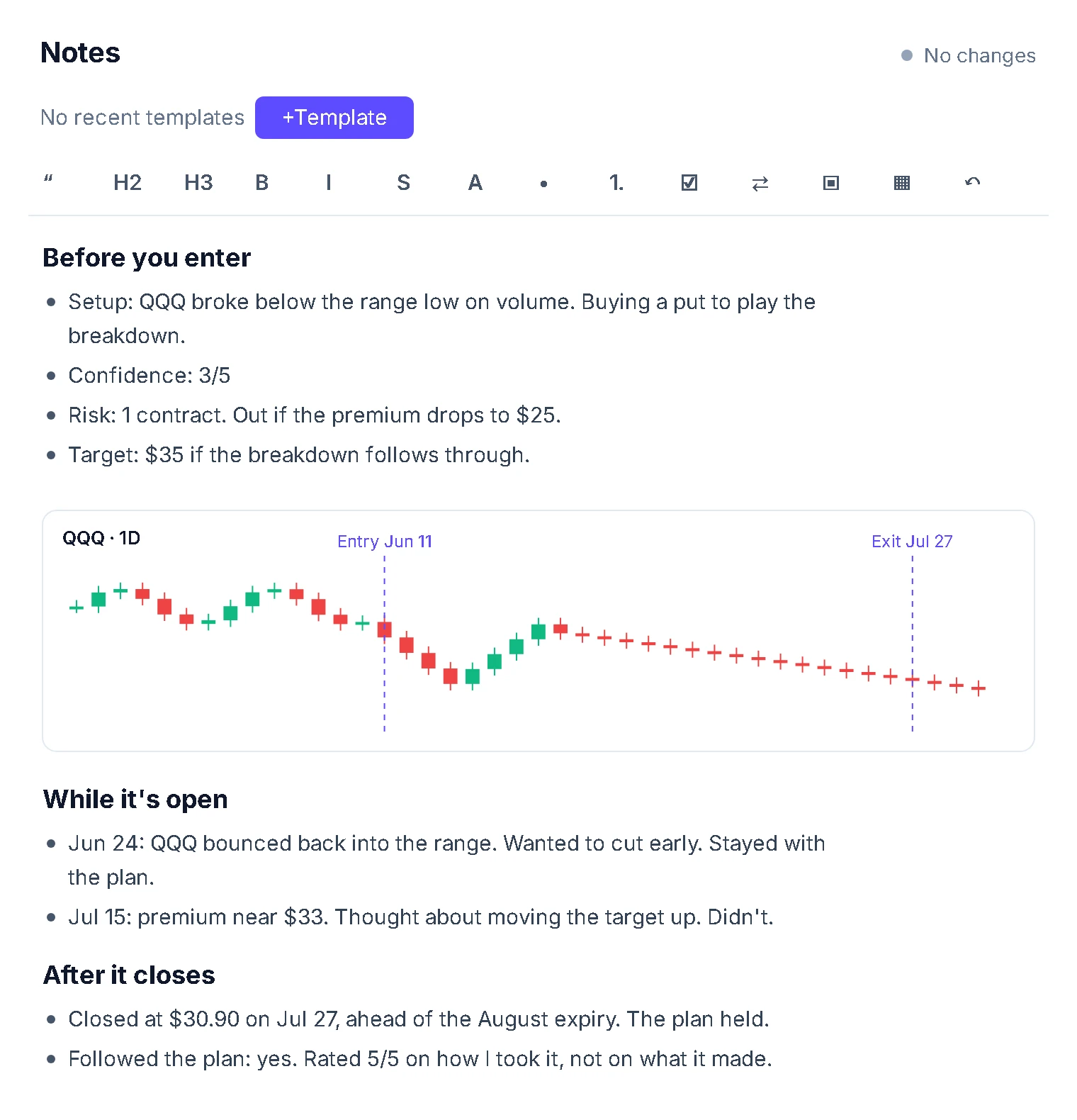
Before you enter: QQQ broke below the range low on volume; buying a put to play the breakdown. Out if the premium drops to $25; target $35. While it's open: Jun 24, QQQ bounced back into the range and I wanted to cut early; stayed with the plan. After it closes: closed at $30.90 ahead of the August expiry. Followed the plan; rated on how I took it, not on what it made.
Two details make this entry useful later. The dollar result uses the multiplier: an option priced at $29.71 controls 100 shares, so a $1.19 move is $119. And the notes were written while the trade was open, so the moment the plan was tested is on record.
What counts as one trade
Before you can count wins and losses, decide what "a trade" is. A simple rule that holds up:
- One contract, one trade — the same underlying, expiry, strike and type (call or put)
- Scaling in or out stays one trade — buying 2 contracts, then 1 more, then selling all 3 is one trade with several fills
- Back to zero starts a new one — close all your contracts and open again, and that's a new trade
Spreads and other multi-leg trades
A vertical spread is two contracts; an iron condor is four. Track each leg as its own line, and tie them together with one strategy name, so you can see the combined result.
Then judge the combination by its net result, not by how many legs won. An iron condor where three legs make money and one loses can still lose money overall, but counted leg by leg it looks like a 75% win rate. Look at the net figure for the strategy, and treat leg counts with care.
Expiry, assignment and rolls
These three events are where most options records go wrong.
Expiry. A contract that expires worthless never has a closing trade, so in a spreadsheet it stays "open" forever. Record it as closed at $0 on the expiry date. In TradeBB, an option still open after its expiry date is closed at $0 on that date.
Assignment. If a short put is assigned, the option is finished and you now own 100 shares per contract at the strike price. Track those shares as a separate stock trade from that day on, and keep the option's own result as it was. When your broker records the assignment, the shares come into TradeBB as a stock trade.
Rolls. A roll is two trades: closing the old contract and opening a new one. Keep them as two, and give both the same tag so you can see the whole chain.
Say you sold an XYZ put for $3.20 ($320). It moved against you, so you bought it back for $4.10 ($410) and sold a later-dated put for $4.50 ($450), which then expired worthless. Leg by leg: −$90, then +$450. As a chain: +$360 before fees. In TradeBB, the Tags report shows the net result for everything under one tag, so the whole roll chain has one number.
Do you need to record the Greeks?
Not for every trade. A full set of Greeks at entry rarely changes what you learn later. What does: one line on what you expected volatility to do, and the rule you'd exit on. Put both in your before-entry note, and you can check afterwards whether the trade worked for the reason you thought.
Spreadsheet or journal?
A spreadsheet works while you trade single legs a few times a week. It starts to strain when you trade spreads, roll positions or get assigned, because every one of those needs extra rows and formulas you maintain by hand.
A journal that understands options does the multiplier, the fees and the grouping for you, so your time goes on the notes. For how TradeBB handles options from import to reports, see the options trading journal. And if you're still building the habit, how to keep a trading journal covers the routine.
Frequently asked questions
Track the stock and each option as separate trades, and give everything in the cycle the same strategy or tag. The combined net result shows what the whole cycle made, including premiums collected and any assignment.
Track the stock and each option as separate trades, and give everything in the cycle the same strategy or tag. The combined net result shows what the whole cycle made, including premiums collected and any assignment.
Per contract, in dollars: price change × 100 × contracts, minus fees. Prices are quoted per share; your account moves by the contract.
Per contract, in dollars: price change × 100 × contracts, minus fees. Prices are quoted per share; your account moves by the contract.
Record it as closed at $0 on the expiry date, so it stops showing as open and its full premium counts.
Record it as closed at $0 on the expiry date, so it stops showing as open and its full premium counts.
As two trades, the close and the new open, with the same tag on both. Add up the tag to see what the whole roll chain made.
As two trades, the close and the new open, with the same tag on both. Add up the tag to see what the whole roll chain made.
Let the multiplier, the fees and the grouping take care of themselves.
Bring in your options trades and spend your time on why you took them.