 TradeBB
How to keep a trading journal, and not quit after two weeks

To keep a trading journal, record a few things on every trade, write one short note each day, and review it once a week. Most traders know that much. Most journals still end within a month.
They rarely end because the format was wrong. They end at one of four points: typing up every trade gets tedious, a backlog builds, every entry starts from a blank page, or the notes pile up and nobody reads them. This guide covers what to record, then how to get past each of those four points.
What to record, and what to skip
Think of it in three layers.
Already in your trade history, so don't type it: symbol, side, size, entry and exit prices and times, profit or loss, fees. Your broker or platform recorded all of it. Copying it by hand is where most journals start to feel like a chore.
Add on every trade, in under a minute:
- Why you took it — one line: the setup, or what you saw
- How well you took it — a score from 1 to 5 for execution, whether the trade won or lost
- One or two tags — the setup, and any habit that showed up, like moved stop or FOMO
Write once a day, after the close: two or three lines. What went to plan, what didn't, and one thing to watch tomorrow.
That's enough to learn from. The rest, like screenshots or detailed market notes, is worth adding when a trade deserves it, not as a rule for every one.
Why trading journals get abandoned, and what fixes each
Typing every trade
If keeping a journal means copying fills into a spreadsheet, it lasts until the first busy week. Let the trades come in on their own: connect your broker so new trades arrive automatically, or export your trade history and upload the file. Either way, your part starts at why, not at what price.
A backlog you don't want to face
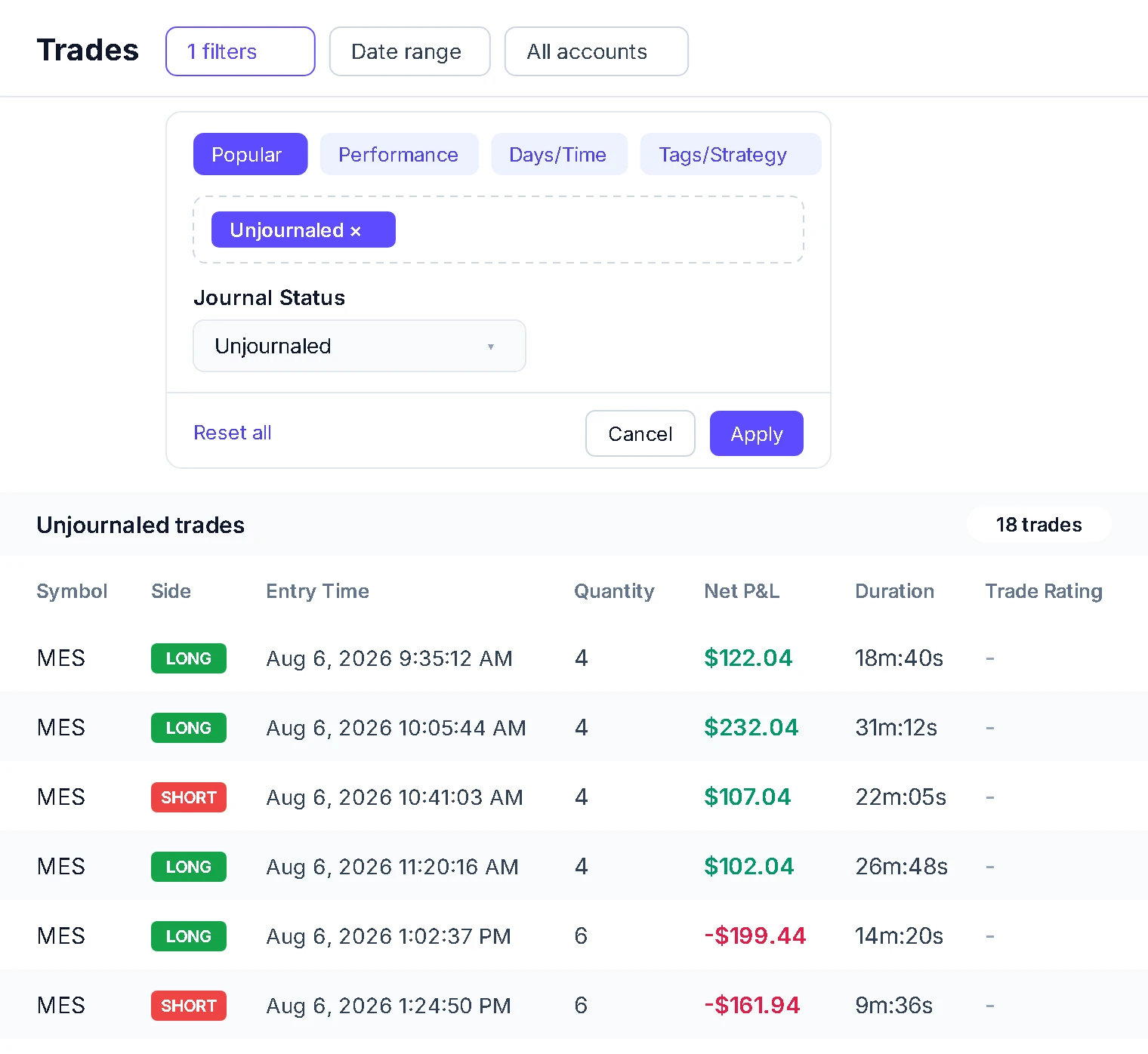
Miss three days and there are forty trades waiting. Facing an open-ended pile is the moment most people stop. Turn it into a list with an end: filter to the trades you haven't journaled yet, start with the most recent, and clear it. A tag and a one-line reason is enough to call a trade done.
A blank page every time
Writing from nothing takes effort, so it gets skipped. Put the same questions on the page every time with a note template: before you enter (why this trade, what you're risking), while it's open (one line on any urge to change the plan), and after it closes (did you follow your rules). You answer instead of compose.
Writing without reading
A journal nobody reads is a diary. Notes only pay off when you go back to them, which is the next section.
A 30-minute weekly review
Pick a fixed time, say Sunday evening, and go through the week in this order:
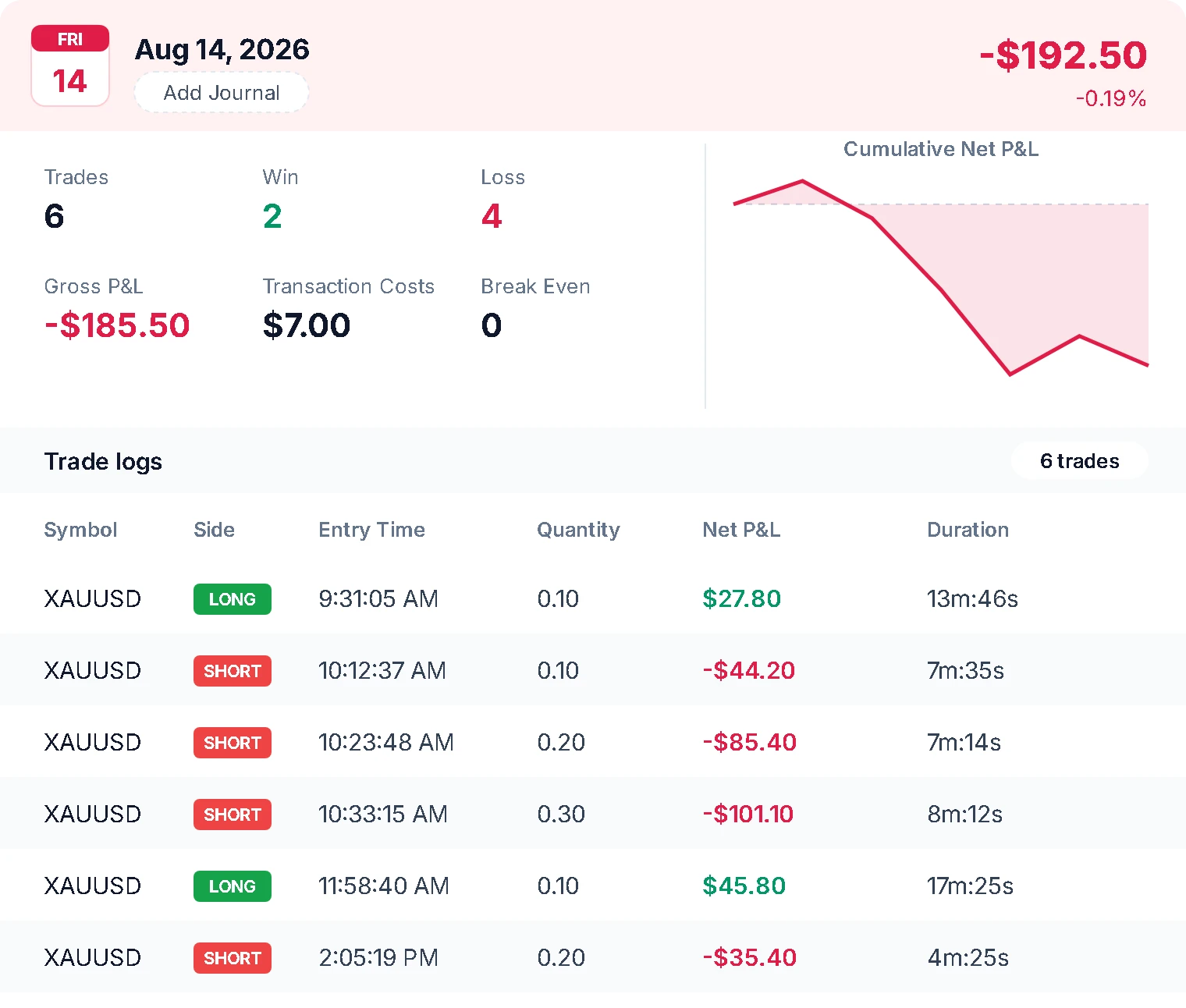
- Find the worst days. Open the calendar and look for the two or three days that cost the most.
- Read those days trade by trade. Open each day's journal and look at the order things happened. Was it one bad trade, or a run of trades after the first loss?
- See which tags cost money. In the tags report, look at net P&L and trade count for each tag. A habit tag with a loss next to it is the one to work on.
- Compare the plan with what you took. If you set stops and targets, compare your average planned R with your average realized R. A big gap means the plan was fine and the execution wasn't. More on that in risk reward ratio.
- Write one rule for next week. One. Put it in your pre-trade template so it's in front of you every time.
Start keeping a journal that fills itself in — Start Your Journal →
What a normal day looks like
- Before the open (2 minutes): in your pre-trade template, write the one setup you're looking for and the loss at which you'll stop for the day
- During the session: trade. Don't journal mid-trade beyond a one-line note if something tempts you to break the plan
- After the close (5 to 10 minutes): your trades are already in. Give each one a reason, a score and a tag, then write two or three lines for the day
That's around ten minutes a day, plus half an hour on the weekend. Small enough to keep doing, which is the whole point.
Spreadsheet, notebook or journal software?
- A notebook is quick to start and good for thinking on paper, but you can't sort or total anything in it.
- A spreadsheet is free and flexible, but you type every trade and build every calculation yourself, and that's usually what stops people.
- Journal software brings the trades in and does the math, so your time goes on the parts only you can write.
Whichever you use, the method above is the same. If you want to see what finished entries look like, see trading journal examples. And if you're choosing a trading journal, pick the one you'll still be opening in three months.
Frequently asked questions
About ten minutes after the close if your trades import automatically, plus a weekly review of around half an hour. If it takes much longer, you're probably typing things your broker already recorded.
About ten minutes after the close if your trades import automatically, plus a weekly review of around half an hour. If it takes much longer, you're probably typing things your broker already recorded.
Every trade. Winners taken badly and losers taken well are the ones that teach you most, and you can't find them if only losses get written down.
Every trade. Winners taken badly and losers taken well are the ones that teach you most, and you can't find them if only losses get written down.
Don't try to reconstruct every old trade in detail. Start from the most recent, give each a tag and a line, and work back as far as you have patience for.
Don't try to reconstruct every old trade in detail. Start from the most recent, give each a tag and a line, and work back as far as you have patience for.
Yes, but keep them in a separate account so their results don't mix with real money.
Yes, but keep them in a separate account so their results don't mix with real money.
When a weekly review ends with one specific rule, and a few weeks later you can see whether the tag it targets is costing you less.
When a weekly review ends with one specific rule, and a few weeks later you can see whether the tag it targets is costing you less.
A journal you'll keep is one that does the typing for you.
Bring in your trades, add the why, and spend your time on the part that makes you better.