 TradeBB
Trading journal examples: four filled-in entries, and what they add up to

A good trading journal entry records what happened, why you took the trade, how well you took it, and one tag for any habit that showed up. That's easier to see than to describe, so here are four complete examples: two single trades and two full days.
They come from a sample account with made-up trades, used throughout TradeBB's guides. The numbers are consistent, so you can check every one. If you'd rather start from a blank sheet, there's a free trading journal template.
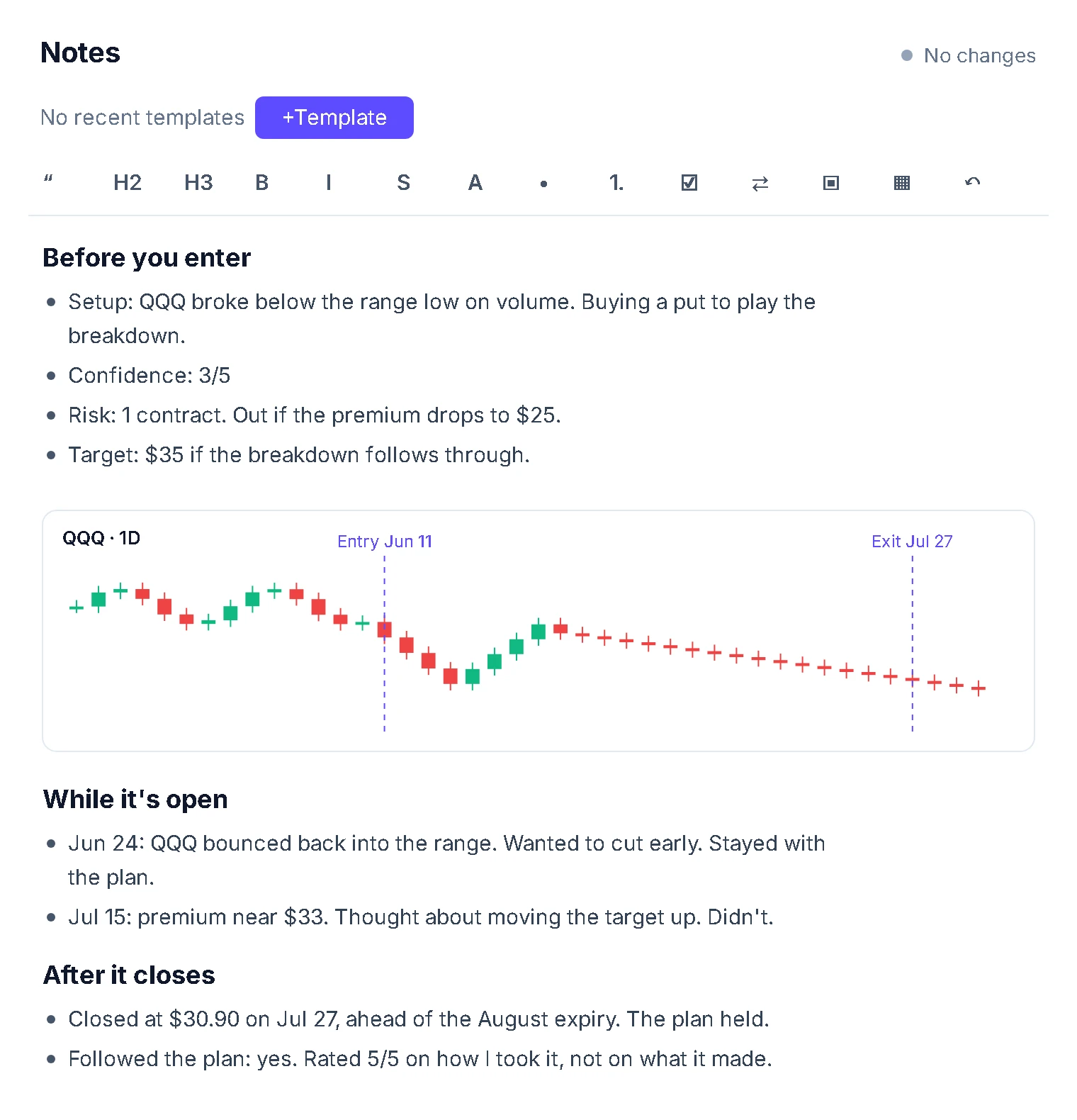
Example 1: an options trade, planned and followed
| Field | Entry |
|---|---|
| Instrument | QQQ Aug 21 2026 700 put, long 1 contract |
| Opened / closed | Jun 11, 2026 at $29.71 / Jul 27, 2026 at $30.90 |
| Held | 46 days |
| Result | +$119.00 gross, $1.81 in fees, +$117.19 net (+3.94%) |
| Plan | Take profit $35.00, stop loss $25.00 |
| Strategy | Breakout |
| Rating | 5 / 5 |
| Tag | Followed the plan |
Before you enter
- Setup: QQQ broke below the range low on volume. Buying a put to play the breakdown.
- Confidence: 3/5
- Risk: 1 contract. Out if the premium drops to $25.
- Target: $35 if the breakdown follows through.
While it's open
- Jun 24: QQQ bounced back into the range. Wanted to cut early. Stayed with the plan.
- Jul 15: premium near $33. Thought about moving the target up. Didn't.
After it closes
- Closed at $30.90 on Jul 27, ahead of the August expiry. The plan held.
- Followed the plan: yes. Rated 5/5 on how I took it, not on what it made.
What makes it a good entry: the notes were written while the trade was open, not reconstructed afterwards. The two moments where the plan was tested, wanting to cut early and wanting to move the target, are on record. Note the rating too: it scores the execution, not the profit.
Example 2: a winning trade, rated 2 out of 5
| Field | Entry |
|---|---|
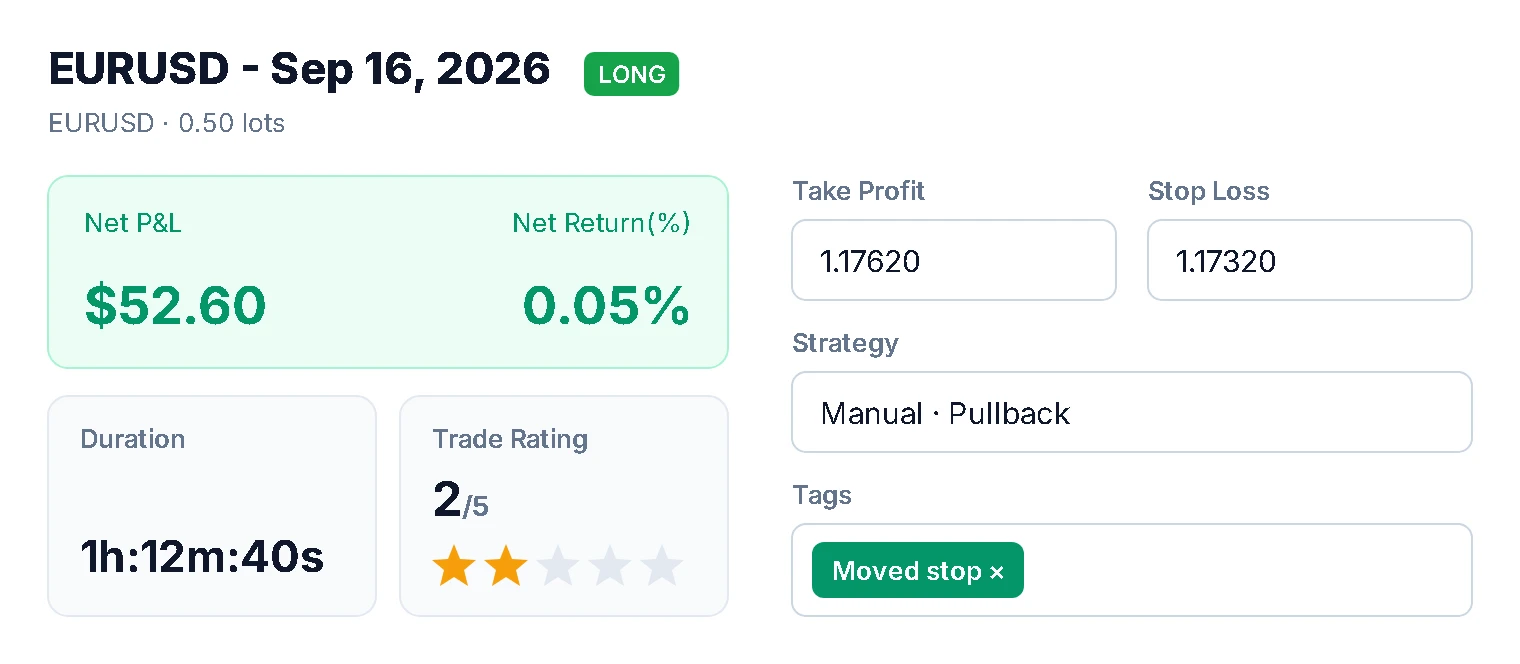
| Instrument | EUR/USD, long 0.50 lots |
| Date | Sep 16, 2026 |
| Entry / exit | 1.17420 / 1.17532 |
| Result | +11.2 pips: +$56.00 gross, $3.40 in costs, +$52.60 net |
| Plan | Stop 1.17320 (10 pips), target 1.17620 (20 pips): 1:2 |
| Held | 1h 12m 40s |
| Strategy | Pullback |
| Rating | 2 / 5 |
| Tag | Moved stop |
After it closes
- Price came within 2 pips of my stop. I moved it 10 pips lower instead of taking the loss. It came back and I closed at +11.2.
- Made money. Broke the plan. If it hadn't come back, this was a 2R loss instead of 1R.
- Rated 2/5: the result was luck, the decision wasn't.
What makes it a good entry: it separates the result from the decision. A profit tagged moved stop and rated 2 is a warning you'd lose if you only looked at P&L. The trade also realized 1.12R against a planned 2R; that gap is covered in risk reward ratio.
Example 3: a day that went wrong after one loss
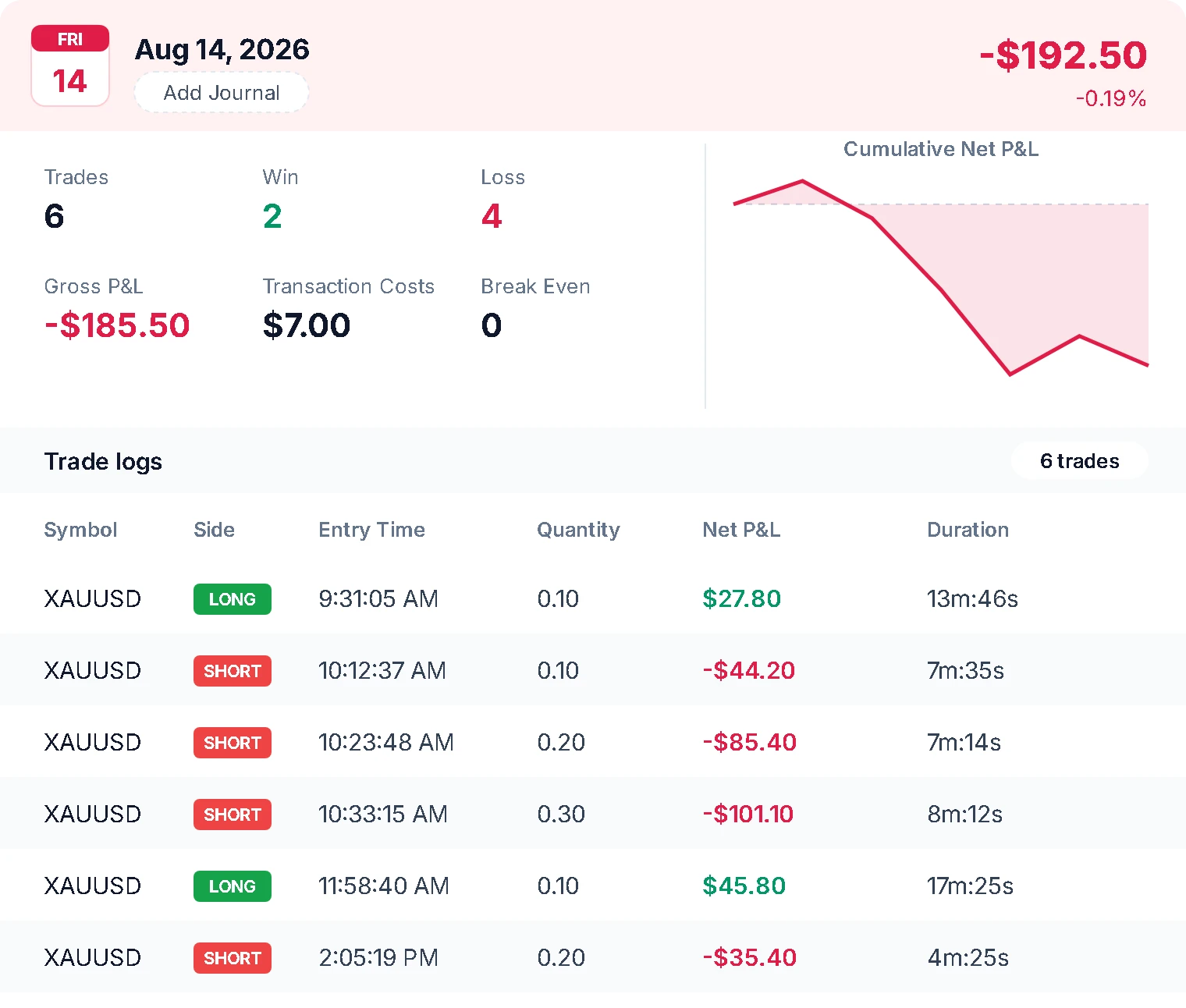
Aug 14, 2026 · XAUUSD · 6 trades · −$192.50 net
| Time | Side | Size | Net P&L | Tags |
|---|---|---|---|---|
| 9:31 AM | Long | 0.10 | +$27.80 | — |
| 10:12 AM | Short | 0.10 | −$44.20 | — |
| 10:23 AM | Short | 0.20 | −$85.40 | Revenge trade, Sized up after a loss |
| 10:33 AM | Short | 0.30 | −$101.10 | Revenge trade, Sized up after a loss |
| 11:58 AM | Long | 0.10 | +$45.80 | Followed the plan |
| 2:05 PM | Short | 0.20 | −$35.40 | FOMO |
Daily note
- First loss at 10:20. Three minutes later I was short again at double size, then triple. Both were about getting it back, not about a setup.
- The 11:58 long was the only planned trade after that, and it worked.
- Tomorrow: after a loss, no new trade for 15 minutes, same size as before.
What makes it a good entry: the times and sizes tell the story on their own, and the tags were added the same evening, while it was still clear which trades were planned. More on this pattern in revenge trading.
Example 4: a green day that wasn't
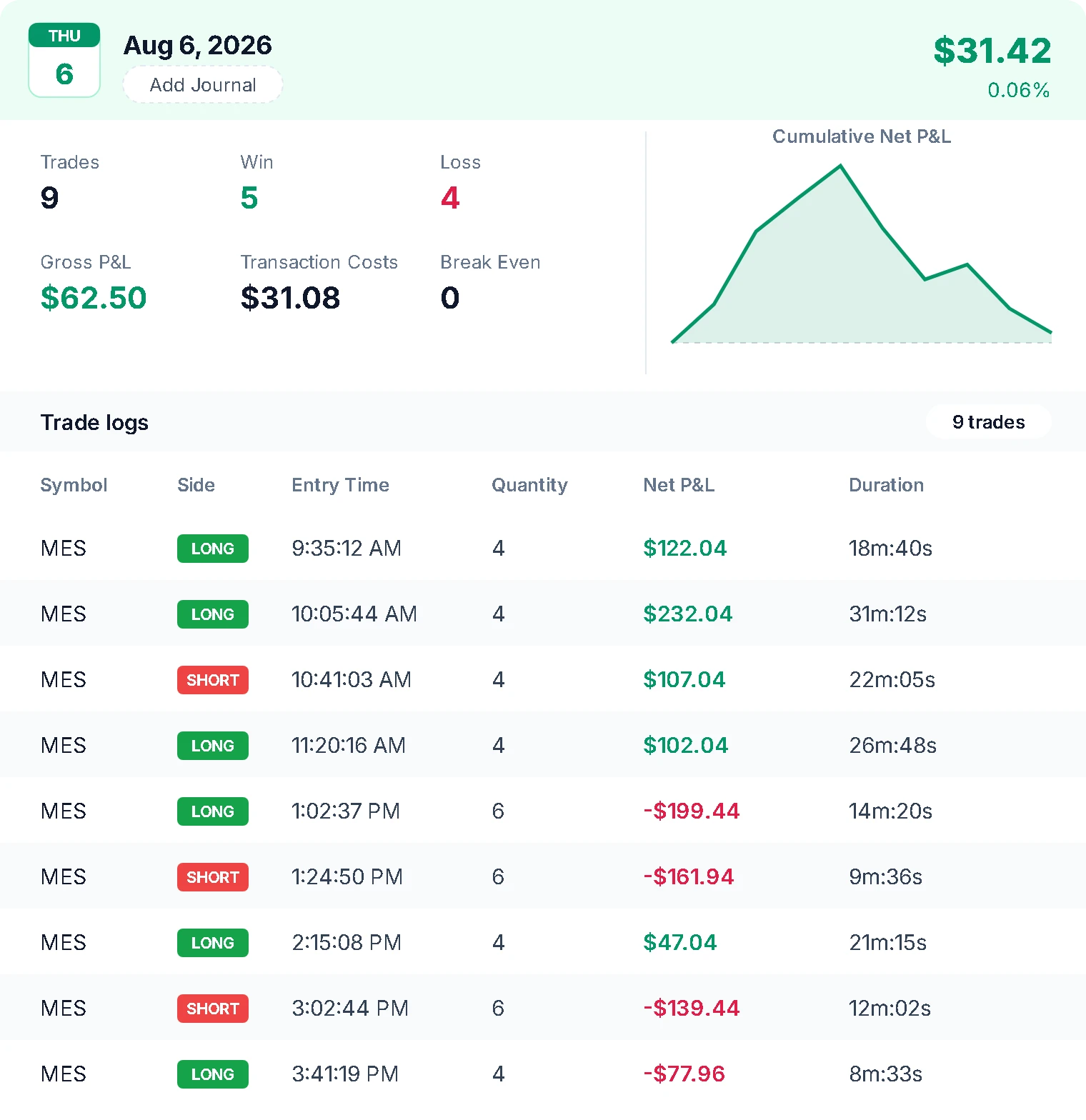
Aug 6, 2026 · Micro E-mini S&P (MES, $5 per point) · 9 trades · +$31.42 net
By 11:47 AM, four trades had the day up $563.16. After lunch, size went from 4 contracts to 6, and the next five trades gave back $531.74. The day still closed green.
And none of the nine trades has a note, a rating or a tag. On the calendar it's a winning day; nothing in the journal says why it nearly wasn't.
The note it needed
- Up $563 by 11:47 on four planned trades. Should have stopped there or kept size at 4.
- Took 6 contracts on the 1:02 and 1:24 trades because the morning went well. Those two cost $361.38.
- Rule to try: after a big morning, no size increase in the afternoon.
What this example shows: a day that ends green can still hold your most expensive habit. Untagged, it disappears into a profitable month. This is exactly the kind of day an unjournaled-trades filter puts back in front of you; see how to keep a trading journal.
What a few months of entries add up to
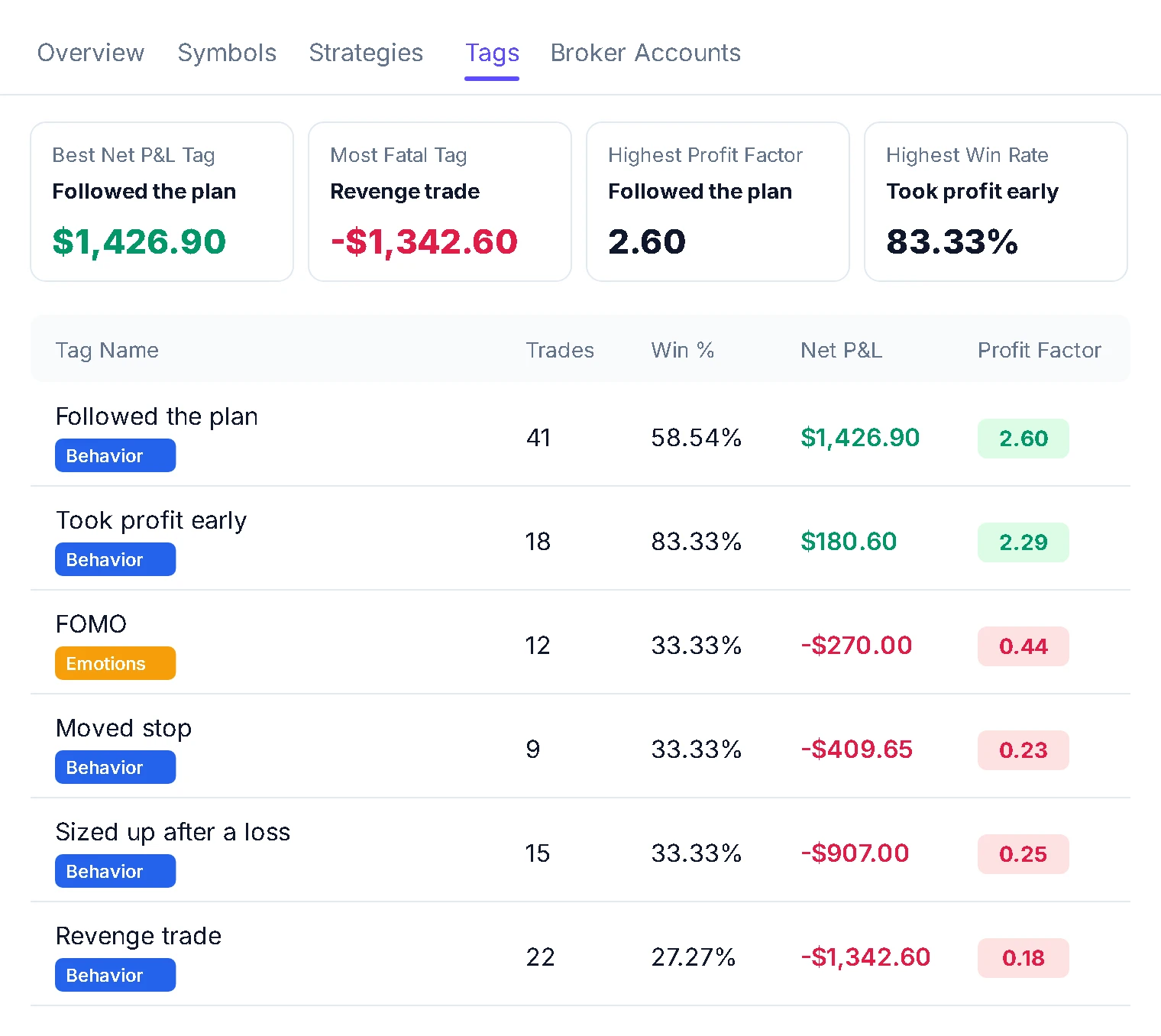
One entry tells you about one trade. A few months of them, tagged the same way, tell you what your habits cost. In the same sample account, from July to September:
| Tag | Trades | Win rate | Net P&L |
|---|---|---|---|
| Followed the plan | 41 | 58.5% | +$1,426.90 |
| Took profit early | 18 | 83.3% | +$180.60 |
| FOMO | 12 | 33.3% | −$270.00 |
| Moved stop | 9 | 33.3% | −$409.65 |
| Sized up after a loss | 15 | 33.3% | −$907.00 |
| Revenge trade | 22 | 27.3% | −$1,342.60 |
The trade in Example 2 is one of the nine moved stop trades: a winner on its own, part of a $409.65 loss as a habit. That's the reason to tag even the trades that worked. Putting a price on habits like these is what a trading psychology journal is for.
Frequently asked questions
The trade itself (your broker records that), one line on why you took it, a 1 to 5 score for how well you took it, and a tag for the setup or any habit that showed up. Add notes when a trade tested your plan.
The trade itself (your broker records that), one line on why you took it, a 1 to 5 score for how well you took it, and a tag for the setup or any habit that showed up. Add notes when a trade tested your plan.
Not every one. Add a chart when the picture explains the decision better than words, like the breakdown in Example 1.
Not every one. Add a chart when the picture explains the decision better than words, like the breakdown in Example 1.
It can be, if you're happy typing every trade and building the formulas. The template gives you a starting sheet; journal software brings the trades in for you.
It can be, if you're happy typing every trade and building the formulas. The template gives you a starting sheet; journal software brings the trades in for you.
No. They're from a sample account with made-up trades, built so every number can be checked.
No. They're from a sample account with made-up trades, built so every number can be checked.
Your own entries can look like these from your first week.
Bring in your trades, add a reason, a rating and a tag, and see your habits add up.