 TradeBB
The prop firm consistency rule, explained with the math

A consistency rule limits how much of your total profit can come from your single best day. If one day makes too large a share, you haven't failed. You usually just need to make more on other days before you pass or can request a payout.
Each firm sets its own limit, from 30% to 55%, and its own details. This guide shows how to calculate it, what going over really costs, and how one set of trading days comes out differently at six firms.
How to calculate the consistency rule
Three lines are all you need:
- Your score = best day ÷ total profit
- Total profit you need = best day ÷ your firm's limit
- Still to make = total profit you need − total profit so far
Here are five trading days:
| Day | Result | Total so far | Best day so far | Best day's share |
|---|---|---|---|---|
| 1 | +$1,300 | $1,300 | $1,300 | 100% |
| 2 | +$400 | $1,700 | $1,300 | 76.5% |
| 3 | −$300 | $1,400 | $1,300 | 92.9% |
| 4 | +$500 | $1,900 | $1,300 | 68.4% |
| 5 | +$600 | $2,500 | $1,300 | 52% |
After day 5 the score is 52%. Under a 50% limit, you'd need $1,300 ÷ 0.5 = $2,600 in total profit: $100 more. To run your own numbers against your firm's rule, use the consistency rule calculator.
Look at day 3. A losing day pushed the share up, from 76.5% to 92.9%, because it shrank your total while your best day stayed the same. At most firms, total profit includes losing days, so a red day after a big day moves you further from the limit, not closer.
Going over the limit doesn't fail the account
This is the part most traders worry about after a big day. At every firm we checked, going over the consistency limit is not a rule violation. What happens instead depends on the firm:
- The target goes up — your profit target becomes your best day ÷ the limit, if that's higher than the original target
- The payout waits — you can keep trading, but can't request a payout until you're back inside the limit
- You keep trading — the evaluation simply isn't complete until the share comes down
The real cost is time. Every extra day you need to bring the share down is another day trading under the loss limits. If your firm uses a trailing drawdown, that's another day for the floor to catch you; see trailing drawdown, explained.
One set of trading days, six different results
The same five days from above, under six firms' rules, as listed on their own sites on October 22, 2026:
| Firm and account | Limit | Applies to | Result with the five days |
|---|---|---|---|
| Topstep, Trading Combine | 55% | Evaluation | Inside (52%) |
| Topstep, Express Funded, Consistency payout path | 40% | Payout eligibility | Over: needs $3,250 total, $750 more |
| Apex, Performance Account | Below 50% | Payout eligibility | Over: needs more than $2,600 |
| FTMO, 1-Step (orders from Oct 12, 2026) | 50% | Challenge and funded account | Over: needs $2,600, $100 more |
| FTMO, 1-Step (earlier orders) | 50% of profitable days only | Challenge and funded account | Inside (46.4%) |
| Earn2Trade, evaluation | Under 30% | Evaluation | Over: needs more than $4,333 |
Two things change the answer besides the percentage:
- What counts as total profit. FTMO's older 1-Step rule only adds up profitable days, so day 3's loss doesn't count against you, and the same days pass.
- "Below" or "up to". Apex requires less than 50%, so exactly 50% isn't enough. FTMO and Topstep's funded path allow up to their limit.
Rules change often. Topstep's own help center lists 55% for the Combine, while several third-party sites still say 50%. Always check your firm's current rules page.
Six things that differ between firms
When you read your firm's rule, find the answer to each of these:
- The limit — 30%, 40%, 50% or 55%, and whether it's "below" or "up to"
- What counts as total profit — net profit including losing days, or profitable days only
- When it applies — to pass the evaluation, to request a payout, or both
- What happens if you're over — a higher target, a delayed payout, or more trading days
- When it resets — some firms start counting again after each payout
- When a day ends — Topstep locks the day's result at 3:10 PM CT; FTMO splits days at midnight Central European time
The last one catches traders in other time zones: your "one big day" can count as two days, or two of your sessions as one.
Check your own trades against a consistency rule
Before you start an evaluation, or before a payout, run the rule on your own history:
- Pick a period — the last 20 to 30 trading days, or everything since your last payout
- Find your best day and your total — on your calendar
- Divide — and compare with your firm's limit
- If you're over — best day ÷ limit tells you the total you need; the difference is what's left to make
Then open the Daily Journal card for that best day and look at the trades behind it. If it came from your normal setups at your normal size, good. If it was one oversized position or a run of extra trades, a consistency rule is pointing at something worth knowing anyway: most of your result depended on one day you might not repeat. That's the kind of question a prop firm trading journal is built to answer.
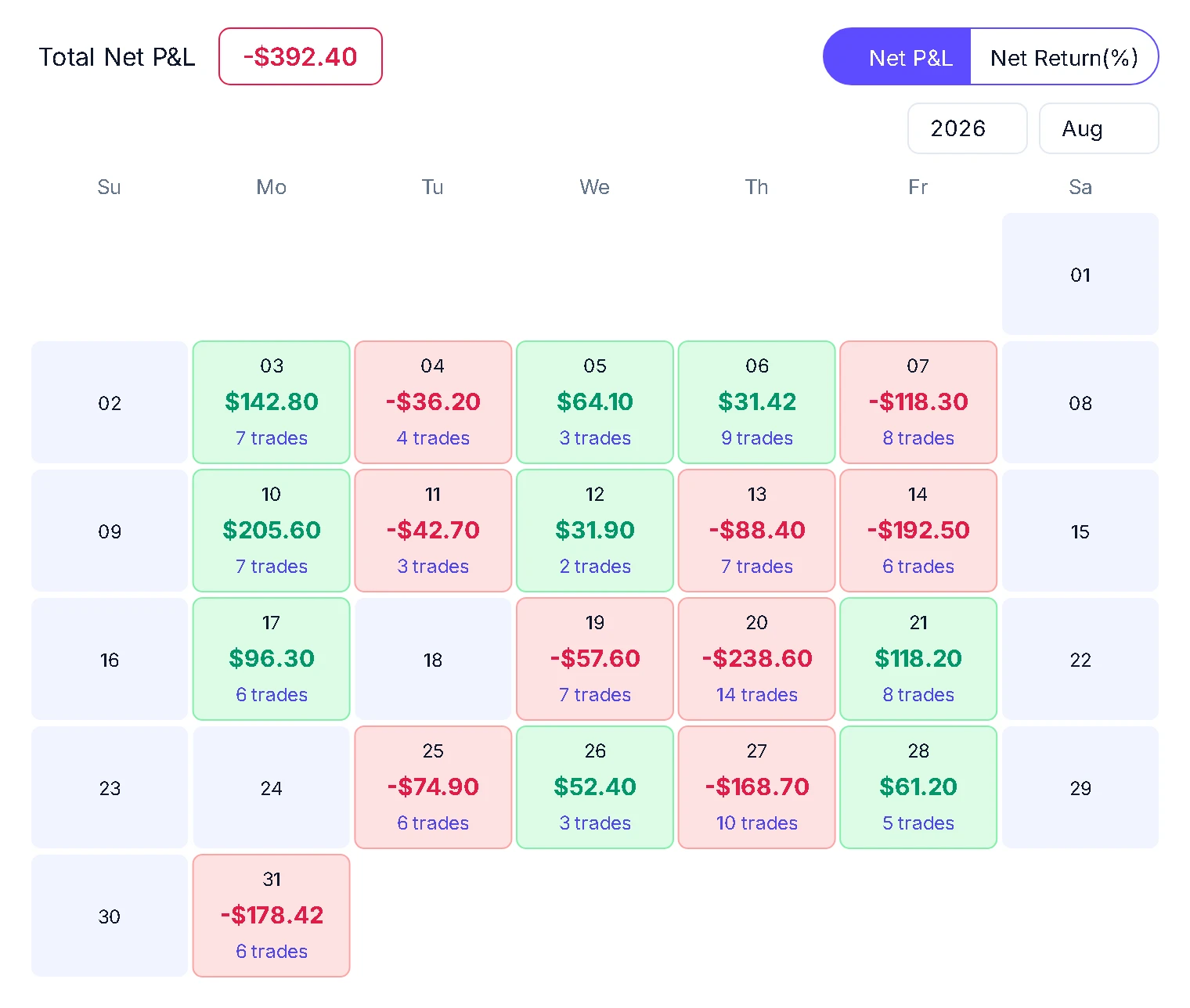
Find your best day and your total — Start Your Prop Journal →
Frequently asked questions
A limit on how much of your total profit can come from your best single day. If one day makes too large a share, you need more profit on other days before you pass or can request a payout.
A limit on how much of your total profit can come from your best single day. If one day makes too large a share, you need more profit on other days before you pass or can request a payout.
At the firms we checked, no. Depending on the firm, your target goes up, your payout waits, or you keep trading until the share comes down.
At the firms we checked, no. Depending on the firm, your target goes up, your payout waits, or you keep trading until the share comes down.
At most firms, yes: total profit is net of losing days, so a losing day raises your best day's share. FTMO's older 1-Step rule counted profitable days only.
At most firms, yes: total profit is net of losing days, so a losing day raises your best day's share. FTMO's older 1-Step rule counted profitable days only.
At some firms. Topstep's funded consistency path and Apex both start counting again after a payout.
At some firms. Topstep's funded consistency path and Apex both start counting again after a payout.
No. Some apply it only to the evaluation, some only to payouts, and some accounts don't have one. For Topstep's full set of rules, see Topstep rules.
No. Some apply it only to the evaluation, some only to payouts, and some accounts don't have one. For Topstep's full set of rules, see Topstep rules.
Know your best day's share before the firm tells you.
Bring in your trades and see every day's result, your best day and your total on one calendar.