 TradeBB
Prop firm challenge: how it works, why most fail, and how to check yourself first

A prop firm challenge is a paid evaluation: you trade an account under the firm's rules, and if you reach a profit target without breaking a loss limit, you can be offered a funded account. You keep a share of the profits; the firm sets the rules.
Most people who buy one don't pass. That's not a secret, but the published numbers are more nuanced than the "90% fail" you'll see repeated, and the reasons people fail split into two very different groups.
This guide covers how a challenge is structured, what the sourced pass-rate data says, the two ways to fail, and how to test your own trading history against a set of rules before you pay for an attempt.
How a prop firm challenge works
Most challenges combine the same handful of rules. The numbers differ by firm, account size and phase, so treat this as a map and your firm's rulebook as the territory.
- Profit target — reach a set percentage of the starting balance
- Daily loss limit — a cap on how much you can lose in one day
- Maximum drawdown — a floor the account can't touch, fixed or trailing
- Minimum trading days — a number of days you must trade before passing
- Consistency rule — at some firms, a cap on one day's share of profit
- Time limit — at some firms, a deadline to reach the target
Many firms use two phases: a first phase with a higher profit target, then a verification phase with a lower one. Some use one. A few have no time limit at all.
The rule that surprises most people is the trailing drawdown, because the floor moves up as your account grows. It gets its own guide.
How many traders actually pass?
Two sources publish numbers with a stated basis. They measure different things, which is why figures quoted online range so widely.
| Source | What was counted | Result |
|---|---|---|
| Topstep, 2025 | Trading Combine attempts completed | 16.8% |
| Topstep, 2025 | Traders who reached a funded account at least once | 51.8% |
| Topstep, 2025 | Funded traders who received a payout | 33.3% |
| FPFX Tech data, reported by Finance Magnates, 2024 | Traders who passed and got a funded account (10 firms, 300,000+ accounts) | about 14% |
| Same report | Traders who passed and then received a payout | about 7% of all traders |
Three things to take from this:
- Attempts and people are different numbers. Topstep's 16.8% counts attempts; its 51.8% counts people, many of whom tried more than once.
- Passing isn't the same as getting paid. In both sources, a large share of funded traders never received a payout.
- The data mixes simulated and live accounts in Topstep's case, and neither source predicts how any one trader will do.
The two ways to fail a challenge
Every failed challenge falls into one of two groups, and they need opposite fixes.
Breached. You broke a rule: hit the daily loss limit, touched the drawdown floor, or broke a consistency or trading rule. The account ends, usually immediately. This is a risk problem. The fix is smaller size and a hard stop for the day.
Ran out. You never broke a rule, but you didn't reach the target in time, or a consistency rule meant your big day didn't count the way you expected. This is a pace problem. Here, cutting size further makes things worse.
Before you buy the next attempt, work out which group your last one was in. If you don't know, your trades can tell you.
Check your own trades against a challenge before you pay
You already have the most useful data there is: your own trading history. Pick the rules of the challenge you're considering, then run five checks against the last few months of your trades. Scale your results to the challenge account size first.
- Daily limit days — how many of your days lost more than the daily limit?
- Worst day — how close did your worst day come to that limit?
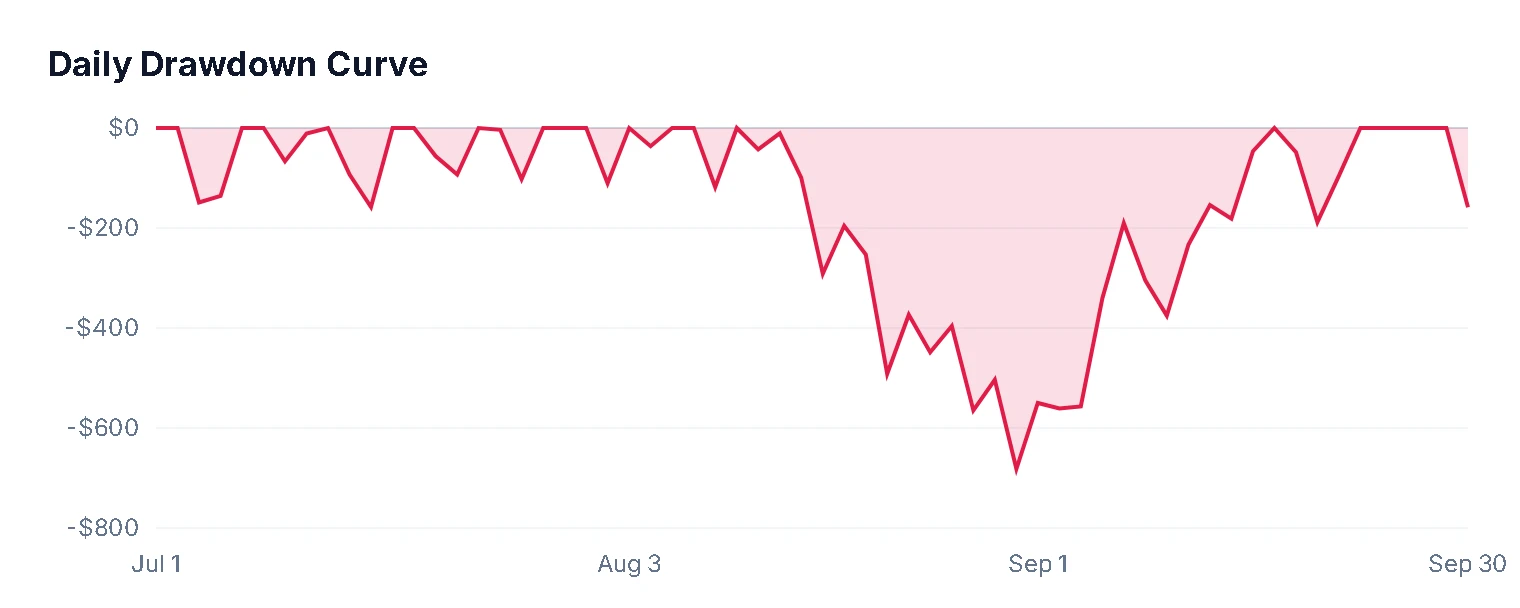
- Deepest drawdown — from your highest point, how far did your account fall, compared with the maximum drawdown?
- Best day's share — what share of your total profit came from your single best day? Compare it with the consistency rule, if there is one.
- Days to target — at your average daily result, how many trading days would the profit target take?
If check 1 finds even a few days, you'd likely have breached. If checks 1 to 3 pass but check 5 says 60 days and the limit is 30, you'd likely have run out. Either answer is cheaper to learn from your history than from a failed attempt.
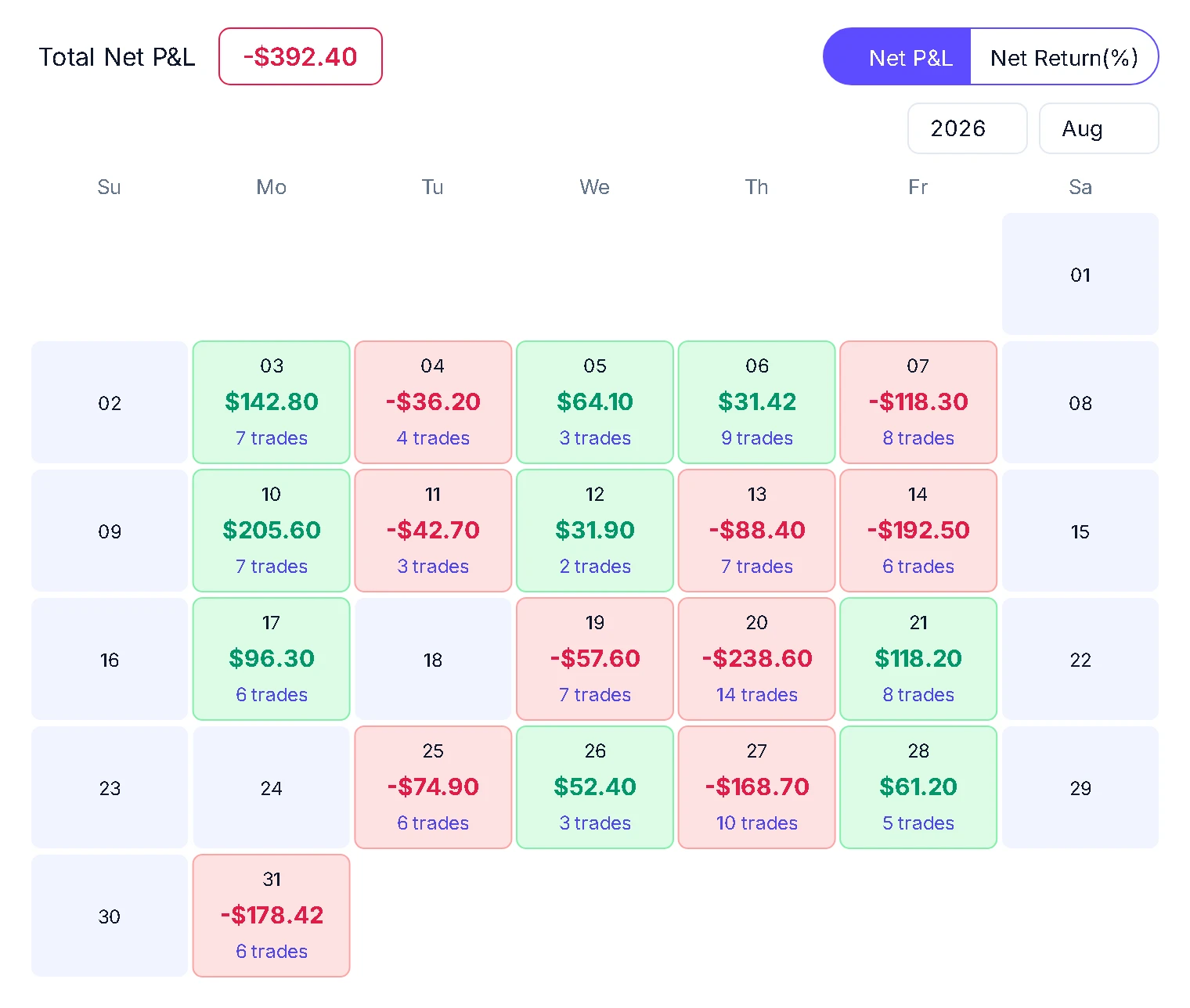
Where to find these in TradeBB. The calendar shows every day's net P&L, so counting days past a limit and finding your worst day takes a minute. The dashboard's daily drawdown curve and trade-by-trade maximum drawdown show how deep your account has been under water. Your best day and your total profit sit side by side on the calendar and the Overview report. And on any day you would have breached, the Daily Journal card lists the trades, so you can see what happened: often the trades after the first loss. That's what a prop firm trading journal is for.
Run the five checks on your own trades — Start Your Prop Journal →
How to pass a prop firm challenge
Once you know which way you'd fail, the fixes are specific.
- Size so your worst day fits — your worst historical day should land well inside the daily limit
- Stop for the day after a set loss — before the firm stops you
- Don't chase the target early — a big first week can backfire under a consistency rule
- Know where the floor is each morning — especially with a trailing drawdown
- Tag the trades around your worst days — the habit usually repeats
Most daily-limit breaches aren't one trade. They're the trade after the loss, taken bigger, or too many trades on a day that was already done.
No journal or strategy guarantees a pass. What your history can do is show you which rule you'd most likely break, before you pay to find out. For the full method, step by step, see how to pass a prop firm challenge.
Frequently asked questions
It depends on what's counted. Topstep reported that 16.8% of its Trading Combine attempts were completed in 2025, while 51.8% of traders reached a funded account at least once. Industry data reported by Finance Magnates put the share who passed at about 14%, and those who also received a payout at about 7%.
It depends on what's counted. Topstep reported that 16.8% of its Trading Combine attempts were completed in 2025, while 51.8% of traders reached a funded account at least once. Industry data reported by Finance Magnates put the share who passed at about 14%, and those who also received a payout at about 7%.
It depends on the firm. Some set a minimum number of trading days and a time limit; others have no time limit. At your own average daily result, you can estimate how many days the target would take.
It depends on the firm. Some set a minimum number of trading days and a time limit; others have no time limit. At your own average daily result, you can estimate how many days the target would take.
Yes. Firms use challenge, evaluation and combine for the same idea: a paid test under the firm's rules.
Yes. Firms use challenge, evaluation and combine for the same idea: a paid test under the firm's rules.
For many traders it's the trailing drawdown, because the floor moves up with your account. The trailing drawdown guide walks through an example.
For many traders it's the trailing drawdown, because the floor moves up with your account. The trailing drawdown guide walks through an example.
Checking your own history against the rules is the cheapest practice there is. If your last three months would have breached, a demo account with the same rules is a sensible next step.
Checking your own history against the rules is the cheapest practice there is. If your last three months would have breached, a demo account with the same rules is a sensible next step.
Check your trades against the rules. Then decide.
Bring in your trades, run the five checks, and find out which rule you'd most likely break before you buy the attempt.