 TradeBB
TRADING TOOLS
Stock Profit Calculator
Enter how many shares you traded and your buy and sell prices to see the profit or loss, in money and in percent, after fees. Switch to target price to find where to sell for the profit you want.
Stock profit is what you sold for minus what you paid, after fees on both sides. Your return is that profit as a percentage of what you paid. Fees also move your break-even price: the price you need just to get back what you put in.
The formula
How to calculate stock profit
Example: buy 100 shares at $50.00 and sell at $65.00. That's $15.00 a share, so the trade made $1,500, a 30% return on the $5,000 you paid.
Add a $5 commission on each side, and the profit is $1,490. You paid $5,005 in total, so the return is 29.77%.
Break-even
Your break-even price after fees
Fees on the way in and out mean the stock has to rise a little before you're even. Break-even = (what you paid + the fee to sell) ÷ shares.
With $5 each side on 100 shares bought at $50.00, that's $5,010 ÷ 100 = $50.10. On a big position, 10 cents is nothing. On a small, quick trade it can be the whole move: buy 1 share at $10.00, sell at $10.02 with $1 each side, and a trade that went up lost $1.98.
The calculator shows your break-even on every result, so you can see how far the price has to move before the trade pays.
Short sales
Profit on a short sale
Shorting works the other way: you sell first and buy back later, and you make money when the price falls. Profit = (short price − buy-back price) × shares − fees.
Short 100 shares at $50.00 and buy them back at $40.00, and the trade made $1,000, a 20% return on the $5,000 position. If your broker charged a borrow fee, add it to the fees to close and the result includes it.
Target price
Find the sell price for a profit target
Switch the calculator to target price and enter the profit you want, as an amount or a percentage. It gives the price to sell at, with your fees already covered.
To make $1,000 on 100 shares bought at $50.00, you'd sell at $60.00. With $5 commission each side, it's $60.10. For a 10% return with the same fees, it's $55.11.
Bought at more than one price? Your stock average calculator gives the average to enter here.
One trade vs the month
Winning trades don't add up to a winning month
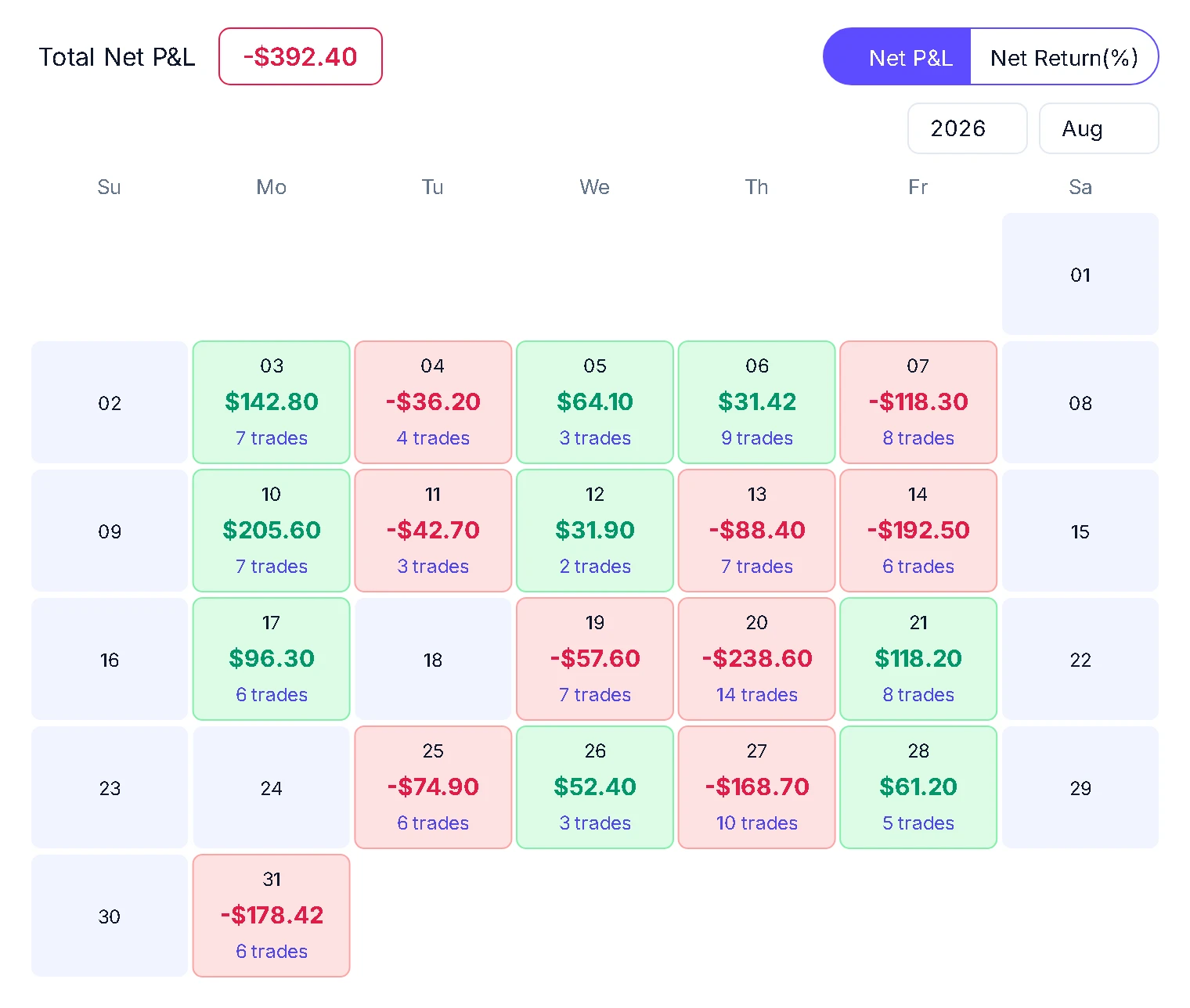
A profit calculator answers one question: what did this trade make? The harder one is what all of them made. A few big losers, or fees on dozens of small trades, can turn a month of mostly winners into a loss.
- Every trade after fees — commissions taken out of each result
- Every day on a calendar — net profit and number of trades per day
- Average win next to average loss — whether your winners pay for your losers
A trading journal does this for every trade you take. For active stock traders, see the day trading journal.
FAQ
Frequently asked questions
How do I calculate profit on a stock?
Subtract the buy price from the sell price, multiply by the number of shares, then take off the fees. 100 shares bought at $50 and sold at $65 is $1,500 before fees.
How do I work out the percentage gain?
Divide the profit by what you paid, including the fee to buy. A $1,490 profit on $5,005 paid is a 29.77% return.
Does the stock profit calculator include taxes?
No. Tax on stock gains depends on where you live and how long you held, so the result is before tax.
Can I use the stock profit calculator for a short sale?
Yes. Switch the position to short, enter the price you sold at and the price you bought back at, and add any borrow fee to the fees.
What if I bought at several prices?
Use the stock average calculator to get your average price, then enter it here as your buy price.
Work out one trade here. See every trade, day and month in your journal.
Bring in your trades and see each one after fees, then the days and months they add up to.