 TradeBB
TRADING TOOLS
Position Size & Lot Size Calculator
Enter your account size, how much you want to risk and where your stop is. The calculator tells you how many lots, contracts or shares to trade.
Position size is how big a trade you take. Set it from your stop, not from a feeling: decide what a losing trade may cost, measure how far away your stop is, and size the trade so hitting that stop costs exactly that amount.
The formula
How to calculate position size
- Money at risk — your account size × the percent you're willing to lose. $10,000 × 1% = $100.
- Stop distance — how far your stop is from your entry, in pips or points.
- Value of that distance — what the stop distance is worth on one lot, one contract or one share.
- Position size — money at risk ÷ value of the stop distance on one lot.
Example: a $10,000 account risking 1% on EUR/USD, with a 20-pip stop. One standard lot of EUR/USD moves $10 per pip, so a 20-pip stop costs $200 per lot. $100 ÷ $200 = 0.50 lots. If the stop is hit, you lose $100, plus any commission.
Lot sizes
What a lot is, and what 0.01 lots means
In forex, a lot is a fixed amount of the base currency. On a USD-quoted pair like EUR/USD, here's what one pip is worth at each size:
| Lot | Units | Value of 1 pip on EUR/USD |
|---|---|---|
| 1.00 (standard) | 100,000 | $10 |
| 0.10 (mini) | 10,000 | $1 |
| 0.01 (micro) | 1,000 | $0.10 |
So 0.01 lots on EUR/USD makes or loses about 10 cents per pip. Most MT4 and MT5 brokers let you trade in steps of 0.01 lots, so the calculator rounds down to the nearest 0.01. Rounding down keeps you at or under your planned risk. To see what a pip is worth on any pair, at any size and in your account's currency, use the pip calculator.
Jpy and cross pairs
Pairs where a pip isn't worth $10
The $10-per-pip rule only works when the second currency in the pair is the US dollar. On other pairs, a pip's value depends on an exchange rate:
- USD/JPY, USD/CAD, USD/CHF: divide by the pair's own price. At USD/JPY 150.00, a pip (0.01 for yen pairs) is worth $1,000 ÷ 150 = $6.67 per standard lot.
- Cross pairs like EUR/GBP or GBP/JPY: you need the rate that turns the second currency into dollars. For GBP/JPY, that's USD/JPY; for EUR/GBP, it's GBP/USD.
Example: $10,000, 1%, a 20-pip stop on USD/JPY at 150.00. Each lot loses 20 × $6.67 = $133.33 at the stop, so you trade $100 ÷ $133.33 = 0.75 lots.
The calculator does this for you. Pick the pair and, for a cross pair, enter the one rate it asks for.
Gold and indices
Gold, US30 and NAS100: check your contract size
Gold and index CFDs don’t have one standard pip, and contract sizes differ by broker. Some platforms count a gold pip as $0.01, others as $0.10, so a "50-pip stop" can mean $0.50 or $5.00. Get that wrong and your position is 10 times too big.
- Gold (XAU/USD): one lot is usually 100 ounces, so a $1.00 move in the gold price is $100 per lot. A $10,000 account risking 1% with a stop $5.00 away trades $100 ÷ $500 = 0.20 lots.
- Index CFDs (US30, NAS100, GER40…): one lot might be worth $1, $10 or another amount per point, depending on your broker.
The calculator works in price distance, not pips, for these. Enter your stop as a price, and check your broker's contract specification once: in MT4 or MT5, right-click the symbol in Market Watch and choose Specification. Put that value in the calculator and the result matches your platform. For gold on its own, with pip value and profit too, use the XAUUSD lot size calculator.
Futures and stocks
Futures contracts and shares
Futures and stocks use the same idea with a different unit.
- Futures: each contract has a fixed dollar value per point. An E-mini S&P 500 (ES) contract is $50 a point; the Micro (MES) is $5. With $100 to risk and a 4-point stop, one ES contract would risk $200, too much, while MES lets you trade 5 contracts. See futures tick values for more contracts.
- Stocks: shares = money at risk ÷ the distance to your stop. Risking $250 with a stop $1.25 below your entry is 200 shares.
Contracts and shares can't be split, so the calculator always rounds down. When even one contract is more than your planned risk, it tells you how much one would risk instead. For profit and loss on 16 futures contracts, use the futures calculator.
Commissions
Leave room for commission
If your broker charges commission per lot, a stopped-out trade costs your stop plus that commission. Size the trade from your stop alone and you lose a little more than you planned every time.
Add your round-trip commission per lot in the calculator and it sizes the trade so stop plus commission stays within your risk. In the EUR/USD example, $7 per lot turns 0.50 lots into 0.48 lots, and the full loss at the stop is $99.36 instead of $103.50.
Prop firm limits
How many losses until your daily limit?
On a prop firm account, the size of each trade decides how many losses in a row you can take before you hit the daily loss limit. Add your firm's daily limit to the calculator and it shows that number for the size you picked.
With $100 at risk per trade and a $500 daily limit, the 5th loss in a row reaches the limit. Touching the limit usually ends the account, so that's the loss that would end it, not one you can afford. For working this out from your own losing streaks, see how to pass a prop firm challenge. If your firm also has a consistency rule, check it with the consistency rule calculator.
Planned vs actual
The risk you plan isn't always the risk you take
A position size calculator gets the size right before you click buy. What happens after is up to you: slippage, a stop moved "just this once", a re-entry after a loss. Over a month, those turn a 1% plan into something else.
- Avg risk per trade — the share of your account you actually had at risk, averaged across your trades
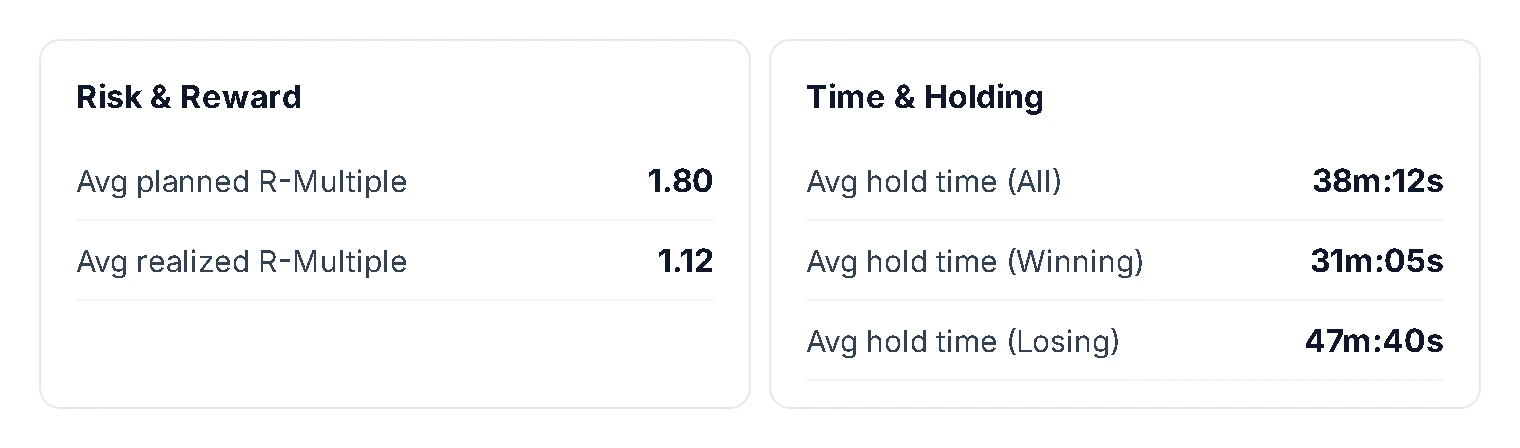
- Planned R next to realized R — from the stop you set and where you really got out
- Losses bigger than 1R — filter for them and see which days and setups they come from
If your losses keep running bigger than your planned risk, the size this calculator gives you is right, and the exits are where the money goes. A trading journal is where you see that.
FAQ
Frequently asked questions
How do I calculate lot size in forex?
Multiply your account size by the percent you'll risk, then divide by your stop in pips times the pip value of one lot. $10,000 at 1% with a 20-pip stop on EUR/USD: $100 ÷ (20 × $10) = 0.50 lots.
How much is 0.01 lots?
1,000 units of the base currency. On EUR/USD and other USD-quoted pairs, that's about $0.10 per pip.
How much should I risk per trade?
That's your call, and it depends on your account and your rules. Many traders keep each trade to around 1% of the account so a run of losses doesn't do lasting damage. Your own longest losing streak is the best guide to what you can take.
Why does my platform show a different lot size for gold or US30?
Contract sizes differ between brokers. Check the symbol's contract specification in MT4 or MT5 and enter that value in the calculator.
Does the position size calculator include commissions?
Only if you add them. Enter your round-trip commission per lot and the size is reduced so your stop plus commission stays within your risk.
Can I use the position size calculator for futures and stocks?
Yes. Pick a futures contract or Stocks, and the calculator gives whole contracts or shares, rounded down.
Size the trade before. See what it cost after.
Bring in your trades and see the risk you actually took on each one, next to the risk you planned.
Risk reward ratio calculator → · How to pass a prop firm challenge →