 TradeBB
TRADING TOOLS
Profit Factor Calculator
Paste your trade results, one per line, or enter your totals or averages. You'll get your profit factor, what a trade makes on average, your win rate, and the win rate your wins and losses need to break even.
Profit factor is what your winning trades made divided by what your losing trades lost. Above 1, the trades made money; below 1, they lost it. Expectancy is the average result per trade. Both should use results after commission and fees.
The formulas
How to calculate profit factor and expectancy
Expectancy = net result ÷ number of trades, which is the same as (win rate × average win) − (loss rate × average loss)
Example: ten trades: +120, −45, +80, −60, 0, +200, −50, −40, +150, −70. The four winners made $550 and the five losers lost $265, so the profit factor is 550 ÷ 265 = 2.08. The ten trades netted $285, so the expectancy is $28.50 a trade, and the win rate is 4 of 10, 40%.
The trade that closed at exactly zero counts as a trade but not as a win or a loss. For the reasoning behind each number, see profit factor, explained.
Win rate and payoff
Your win rate only means something next to your average win and loss
A 40% win rate can make money and a 60% win rate can lose it. What decides it is how big your wins are compared with your losses. The win rate you need to break even is:
- Win $200 on average and lose $100: you need to win 33.3% of the time
- Win $100 and lose $100: you need 50%
- Win $50 and lose $100: you need 66.7%, so a 60% win rate still loses money
The calculator shows your break-even win rate next to your actual one. For one planned trade, the risk reward calculator does the same from your stop and target.
After costs
Use results after commission and fees
Work these out from gross results and they flatter you. Take the same ten trades with $3 of commission on each. Every winner shrinks, every loser grows, and the trade that closed at zero becomes a $3 loss.
The profit factor drops from 2.08 to 1.90, the expectancy from $28.50 to $25.50, and there are now six losers instead of five. The win rate stays at 40%, which is why it's the number least likely to warn you about costs.
Paste your results after costs and the calculator gives the numbers that match your account.
Expectancy in r
Expectancy in R, so accounts of any size compare
A dollar expectancy depends on how much you risk. Measured in R, where 1R is the amount you risk on a trade, it doesn't. Switch the unit to R and enter your averages in R.
Example: win 40% of the time, average win 2R, average loss 1R. The expectancy is 0.4 × 2 − 0.6 × 1 = 0.2R a trade, and the profit factor is 0.8 ÷ 0.6 = 1.33. Risking $100 a trade, that's $20 a trade on average; risking $500, it's $100.
How TradeBB works out R on each trade is in R-multiple, explained.
By strategy
One profit factor hides which setup is paying
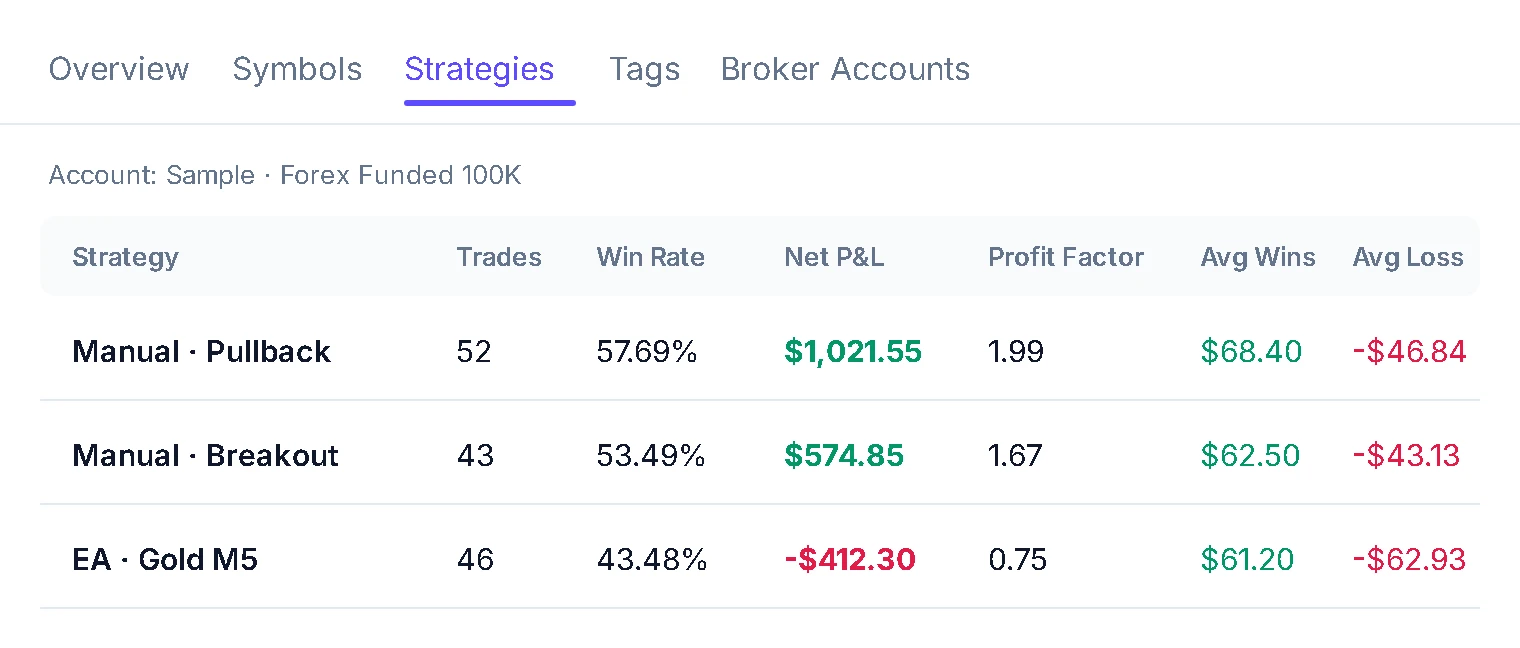
A profit factor for all your trades is an average of the good setups and the bad ones. In the sample account below, two strategies run at 1.99 and 1.67 while a third sits at 0.75, losing $412. Together they still make money, which is exactly why the total doesn't warn you.
- Profit factor and win rate per strategy — next to each strategy's net result
- The same numbers per tag — mistakes, market conditions, whatever you track
- Expectancy per trade on your dashboard — updated with every import
A trading journal works these out from every trade, after costs, and splits them for you.
FAQ
Frequently asked questions
How do you calculate profit factor?
Add up what your winning trades made, add up what your losing trades lost, and divide the first by the second. $550 won and $265 lost is a profit factor of 2.08.
How do I calculate my trading expectancy?
Divide your net result by the number of trades. Or multiply your win rate by your average win, and subtract your loss rate times your average loss. Both give the same answer.
What is a good profit factor?
Above 1 means the trades made money, and below 1 means they lost it. How far above 1 is enough depends on how many trades it's based on and whether costs are already taken out.
What if I have no losing trades?
Then there's nothing to divide by, so profit factor can't be calculated. The calculator shows a dash and still gives your expectancy and win rate.
Do break-even trades count?
They count toward your number of trades, so they lower your win rate and your expectancy a little. They don't change your profit factor.
Check a batch of trades here. See every strategy's numbers in your journal.
Import your trades and TradeBB works out profit factor, expectancy and win rate after costs, for every strategy and tag.